Insights
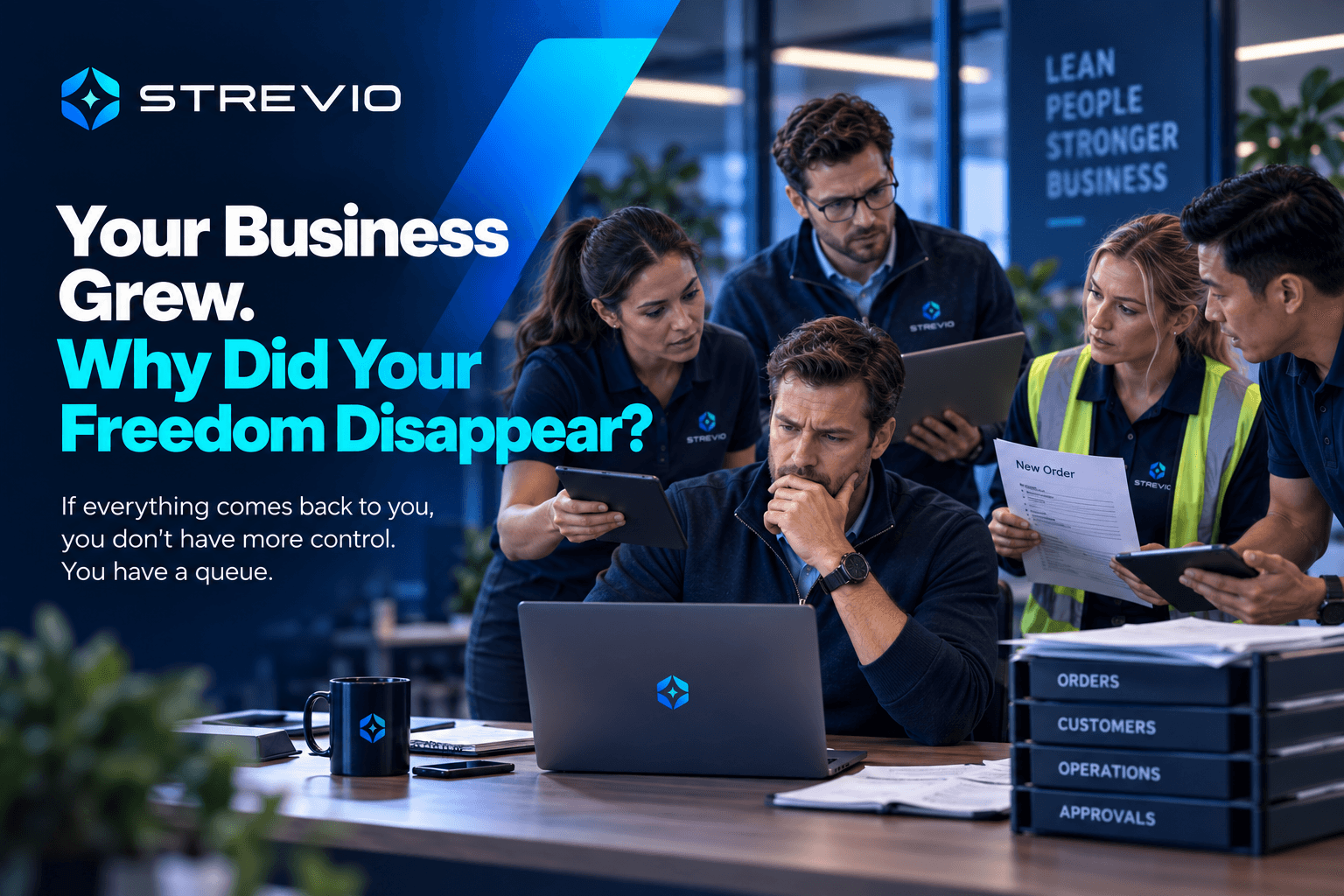
Your Business Grew. Why Did Your Freedom Disappear?
If everything comes back to you, you don't have more control. You have a queue.
In This Article
- Being Busy Is Not the Same as Being Useful
- This Usually Starts Because You Are Good at Running the Business
- The Owner Becomes the Fastest Route to an Answer
- If Everything Comes Back to You, You Have Built a Queue
- Hiring a Manager Does Not Automatically Fix It
- Delegating the Job Is Not Enough
- Sometimes You Are Involved Because Nobody Else Can See the Whole Picture
- The Business Can Become Dependent on Your Memory
- Being Needed Can Feel Like Control
- The One-Week Test
- Look at the Questions, Not Just Your Calendar
- The Cost Is Not Only Your Time
- This Can Also Put a Ceiling on Growth
- We Have Seen What Happens When Management Stops Chasing the Business
- Manufacturing Shows the Same Pattern at a Larger Operational Scale
- More Meetings Are Usually a Symptom
- Adding Another Dashboard Can Fail for the Same Reason
- Clear Authority Is Just as Important as Clear Information
- The Owner Should See Exceptions, Not Every Transaction
- Your Business Should Need Your Judgment More Than Your Availability
- There Is Another Reason to Fix This: What Is the Business Worth Without You?
- Succession Starts Long Before You Retire
- Seven Signs the Business Is Too Dependent on You
- What Should You Change First?
- Technology Can Help, but It Cannot Decide Who Owns the Business
- The Better Goal Is Not to Become Irrelevant
- Ask Yourself This Tomorrow Morning
- Growth Should Give the Owner More Options, Not Fewer
You started with a small team. Everyone sat close together. You knew every customer, every supplier and almost every order. Someone had a question about price, they asked you. A supplier was late, you knew who to call. A customer wanted something unusual, you made the decision. There was a stock problem, you probably knew why before anyone finished explaining it.
At that stage, having everything come through you was not necessarily a problem. It was often the fastest way to run the company.
Then the business grew. Five people became ten. Ten became twenty. There were more customers, more suppliers, more orders and more employees. You hired people precisely because the company was getting bigger. Yet something strange happened. You became busier. Not just with bigger decisions. With more questions.
- "Can we confirm this delivery?"
- "Can we give this customer another 5%?"
- "The supplier is late. What should we do?"
- "Can I approve this freight charge?"
- "Which stock number should I use?"
- "Can we hire this person?"
- "This customer is asking for an exception."
- "Have you seen the report?"
None of those questions sounds unreasonable. But there are now dozens of them. Your morning starts with WhatsApp. Your day is interrupted by people needing decisions. You finish a meeting and find another eight messages waiting. You go on holiday and keep checking your phone because you know certain things will stop if you do not reply.
The company became larger. Your role did not really change with it. And at some point you realize something uncomfortable:
The business grew, but your freedom did not grow with it.
In some cases, it actually disappeared.
Being Busy Is Not the Same as Being Useful
Most owners do not have a problem working hard. They built companies. Hard work comes with the territory. The more interesting question is what their time is being used for.
Business.com studied 550 leaders of companies with between 5 and 249 employees. Importantly, 62% of those leaders worked in companies with between 5 and 50 employees, which makes the sample relatively close to the type of owner-managed SME we are talking about here.
46% / 6.6 hrs
of leaders described operational inefficiency as a core challenge, and those operational problems consumed an average of 6.6 hours of their time every week
Business.com, survey of 550 SME leaders
One in four admitted they were micromanaging their teams. Excessive multitasking and switching between different activities was costing leaders around nine hours a week.
41% / 35%
of leaders wanted to spend more time on growth opportunities, yet only 35% said they actually did so regularly — the average time spent on growth was roughly four hours per week
Business.com
That probably feels familiar to many owners. You have a list of things you know you should be doing. Meet an important customer. Develop a new market. Recruit a strong commercial person. Improve a supplier relationship. Work on a new product. Think about next year.
Then Monday happens. By lunchtime, a delivery is late. There is a problem with an invoice. Someone needs approval. A customer wants an answer. Your operations manager needs ten minutes. Then finance needs another ten minutes. Then somebody sends you a spreadsheet that you need to understand because they are not comfortable making the decision without you.
Friday arrives. You worked all week. But the important things on your list are still there.
This Usually Starts Because You Are Good at Running the Business
Owner dependency is often described badly. People say:
- "You need to delegate."
- "Stop micromanaging."
- "You need to let go."
That advice can be irritating because it ignores why the situation exists. The owner often became central to everything because the owner is the person who understands the business best.
You know which customer is worth making an exception for. You know that one supplier always promises Friday but really means Tuesday. You remember the pricing history. You know which employee can handle pressure. You understand where the margin really comes from. You remember why a strange stock arrangement exists.
When the company is small, all of that knowledge inside one person's head is extremely efficient. There is no need for a committee. Someone asks. You decide.
The problem appears later. The number of decisions increases with the size of the business, but your brain still has the same number of hours in the day. More customers create more exceptions. More suppliers create more changes. More staff create more handovers and more questions. More orders create more commitments that somebody needs to watch. Eventually, the same involvement that made the company effective in the beginning starts to slow it down.
McKinsey recently studied more than 2,700 founder-led companies and interviewed more than 40 founders to understand what happens as businesses become much larger. Their companies are far bigger than the typical STREVIO client, so the scale is different. The management problem is surprisingly similar.
McKinsey describes a point where founders become spread too thin and daily operational and financial decisions can no longer keep flowing upward without slowing the organization. They suggest a useful test: think about the last 20 decisions you were involved in — how many could your management team have made without you? McKinsey argues that if the answer is more than half, the founder may have become the company's main bottleneck.
For an SME owner, an even simpler version of the question is:
Think about the last 20 questions your team brought to you. How many genuinely needed you?
That can be quite revealing.
The Owner Becomes the Fastest Route to an Answer
Imagine you have an operations manager. They are competent. A customer order is at risk because a supplier is late. The manager needs to decide whether to pay for a more expensive shipment. They check the ERP. The supplier's latest date is not there. They check email. Then they look at the customer order. The margin is unclear because part of the freight is sitting somewhere else. The customer is important, but nobody has defined how much extra cost can be approved without escalation.
What happens? They ask you. You answer in three minutes. Problem solved.
From the outside, that looks efficient. It is efficient for that one decision. But now imagine the same thing happens 15 times a day. The organization has quietly learned something:
When the information is unclear, ask the owner. When there is an exception, ask the owner. When nobody knows the limit of their authority, ask the owner.
You become the easiest solution to every gap in the business. Our own buying-moment research describes this exactly:
If I'm not there, everything slows down.
Everyone comes back to me for answers.
We classify this as a Very High severity business problem because the consequences include slower decisions, lost owner time, key-person dependency and eventually a limit on how much the company can grow.
If Everything Comes Back to You, You Have Built a Queue
Owners often say: "I like to stay in control." Fair enough. You probably should stay in control of the things that matter. But control and involvement are not the same thing.
Imagine every purchase above HK$5,000 requires your approval. Every discount needs your approval. Every difficult customer question comes to you. Every unexpected freight cost comes to you. Every stock discrepancy comes to you. Every hiring decision comes to you.
You certainly know what is going on. You also have a growing line of people waiting for you to answer. That is the problem. When twenty people depend on one person's availability, the company can only move as quickly as that person can process decisions.
You may feel more involved. The business is not necessarily more controlled. It may simply be waiting.
Hiring a Manager Does Not Automatically Fix It
This is one of the most common attempts to solve the problem. The owner is overloaded. So the company hires an operations manager. Good idea.
Then three months later, the owner is still involved in almost everything. Why? Because the new manager has responsibility but not enough information or authority.
They are responsible for customer delivery, but they cannot see the complete order position without asking procurement. They manage inventory, but the stock figure is not fully trusted. They manage the supplier issue, but nobody has agreed what they are allowed to spend solving it. They manage the team, but every unusual decision still needs owner approval.
Now the company has added another salary. The questions still come back to the owner. Sometimes there is actually another step in the chain: employee asks manager, manager asks owner, owner answers manager, manager answers employee. You hired somebody to create distance between you and the problem, but the decision still travelled all the way to you.
Delegating the Job Is Not Enough
Suppose you tell your operations manager: "From now on, you handle all delivery problems." That sounds like delegation.
Then an important customer order becomes late. The manager has three options: pay HK$8,000 for expedited freight, wait five days, or split the shipment. Which option should they choose?
If they cannot see the customer value, margin, available stock and latest supplier status, they cannot make a confident decision. Even if they have the information, they may not know whether HK$8,000 is within their authority. So they come back to you.
This is why a company can have good managers and still remain dependent on the founder. People need enough information to understand the problem. They need to know what they own. They also need to know the limits within which they can decide. For example:
If the additional freight is below HK$5,000 and the customer margin remains above our agreed level, solve it. You do not need me.
Now there is something the manager can actually work with. The specific rule will be different in every company, of course. The point is that people need more than a job title. They need a way to make normal decisions without asking for permission every time.
Sometimes You Are Involved Because Nobody Else Can See the Whole Picture
This is where the previous articles in this series connect. Your customer-service person cannot answer a delivery question because the information is spread across ERP, Excel and email. They ask operations. Operations cannot confirm the stock without checking another spreadsheet. Procurement knows the supplier is late. Finance knows the margin.
You are the only person who naturally joins all those pieces together because you have been involved in every part of the business for years. So the question comes to you. It looks like a leadership problem. Part of it is actually an information problem.
This distinction matters. Sometimes the owner is involved because a real decision requires experience. Sometimes the owner is involved because nobody else can see the full picture. Those are not the same situation.
The first is healthy. The second is expensive.
The Business Can Become Dependent on Your Memory
This happens gradually. Someone asks: "What price did we agree with them last year?" You remember. "Why do we keep this stock separately?" You remember. "Which supplier did we use before?" You remember. "Can this customer pay at 60 days?" You know them personally. "What happened the last time this product was delayed?" You remember that too.
This knowledge is valuable. But if the only reliable copy lives in your head, the company has a problem.
The larger the company becomes, the more dangerous this dependency gets. Decisions become slower when you are unavailable. Employees become less confident because they have learned that the safest answer is to wait. New managers struggle because experienced employees know things that were never written down. And eventually you cannot distinguish between questions that genuinely require your judgment and questions that only require information that nobody else can find.
Being Needed Can Feel Like Control
There is another reason this problem can stay hidden for years. Being needed does not always feel bad. It can feel satisfying.
Your team trusts you. Customers know you. Suppliers respect you. You solve difficult problems quickly. You walk into a room and something that had been stuck for an hour gets resolved in five minutes. That feels like good leadership. Sometimes it is. The question is what happens when you are not in the room.
McKinsey makes a similar point in its research on founder-led companies. The instincts and hands-on involvement that helped a founder create the company can eventually become constraints once complexity increases. The founder's role has to evolve as the business evolves.
A business cannot grow indefinitely by increasing the number of situations where one person needs to intervene. At some point, good leadership includes designing the company so normal work can continue without you.
The One-Week Test
Here is a practical test. Imagine you leave tomorrow for one week. You can receive genuine emergency calls. Otherwise, you are unavailable. What stops?
- Do customer orders keep moving?
- Can procurement handle normal supplier problems?
- Can your managers approve routine exceptions?
- Can customer service answer questions?
- Can somebody understand stock availability without calling you?
- Can the team make normal pricing decisions?
- Can invoices and payments move through the process?
- Do managers know which problems genuinely need escalation?
- When you return, do you find 120 WhatsApp messages asking for decisions?
The purpose of the test is not to prove the company should never need you. Of course it needs you. You own it. You lead it. The interesting part is what it needs you for.
If the business needs your judgment on a major customer negotiation, fine. If it needs you because nobody knows whether the supplier confirmation was updated in the spreadsheet, that is different.
Look at the Questions, Not Just Your Calendar
Owners often try to solve this by managing their time more aggressively. Block the morning. Turn off notifications. Create meeting-free days. All useful. But if the underlying business still requires your decisions, the questions do not disappear. They wait.
A more useful exercise is to look at the questions themselves. For one week, notice every interruption. Then separate them mentally.
Some genuinely belong with you: large commercial decisions, important hiring, major customer negotiations, strategic investments, serious cash issues, key supplier relationships.
Others may not: routine discounts, normal freight decisions, standard customer exceptions, stock checks, report requests, supplier status, small purchasing approvals, questions whose answer already exists somewhere.
The second group tells you where the business is dependent on your availability rather than your actual value.
The Cost Is Not Only Your Time
If you spend six hours a week on operational questions, the obvious cost is six hours. But there are other costs.
While someone waits for you, their work is delayed. While a manager waits for approval, the customer waits too. Employees who need permission for everything eventually stop making decisions. Strong managers can become frustrated. Junior employees never develop judgment because difficult situations always move upward. Meetings multiply because managers need to align before presenting something to you. The organization starts protecting itself against mistakes by adding more approval. Every extra approval makes the organization slower. Then management complains that staff lack initiative. It is an unpleasant cycle.
This Can Also Put a Ceiling on Growth
Our Buying Moments research captures another recurring situation:
Every time we grow, we need more people just to keep up.
As more business creates more follow-up, meetings, checking and hiring, operational complexity starts rising almost as quickly as revenue. Now add owner dependency. You may be able to hire three more employees. You cannot hire another version of yourself. If those employees each create additional decisions that come back to you, growth eventually creates more work than you can personally process.
This is where companies sometimes stop growing even though demand still exists. The market is not the problem. The internal decision load is.
We Have Seen What Happens When Management Stops Chasing the Business
Hong Kong wholesale and distribution business
One Hong Kong wholesale and distribution business we worked with had growing order volumes, international suppliers and an ERP already in place. As activity increased, management spent a significant part of every day chasing supplier updates, checking order status and answering customer questions.
Purchase orders, supplier confirmations, shipment information and customer commitments were spread across the ERP, spreadsheets and email. Managers gradually became coordinators. Instead of using their experience to improve supplier performance or develop the business, they were spending their time finding information.
STREVIO connected the relevant operational information into a shared view and introduced automated monitoring for normal activity and exceptions.
Measured Results
- 60% less manual procurement tracking
- More than 3 hours recovered every day across procurement and operations
- 35% more orders handled by the same operations team without increasing headcount
Nobody removed management from the operation. Management simply stopped being the mechanism used to move basic information around the company.
Read the full Wholesale & Distribution storyManufacturing Shows the Same Pattern at a Larger Operational Scale
Manufacturing business: five departments, five different pictures
We saw something similar in a manufacturing business. Procurement had one view. Production had another. Inventory had another. Sales had another. Important ERP information existed, but teams still relied on departmental files and manual checks.
When a supplier was late, somebody needed to understand whether it would affect production and which customer orders would be at risk. That answer often required several departments to rebuild the picture. The same information was checked, copied or reformatted more than once. Management reports needed manual consolidation. Bottlenecks were often discovered once they had already become urgent.
Measured Results
- 70% less manual coordination and repeated checking between departments
- 80% faster operational and management reporting
- 35% more operational throughput without increasing administrative resources
The manager did not become less important. The manager had fewer reasons to spend the day reconstructing the operation.
Read the full Manufacturing storyMore Meetings Are Usually a Symptom
If information is unclear, people meet. Monday operations meeting. Daily stand-up. Sales and operations meeting. Procurement meeting. Management meeting. WhatsApp group in between.
There is nothing wrong with meetings. A good operational meeting can be extremely valuable. But ask what the meeting is doing. Are people making decisions? Or are they telling each other what happened because nobody can see it elsewhere?
If half the meeting consists of "Where is this order?", "Did the supplier reply?", "How much stock do we actually have?", "Which customer is affected?", "Can somebody update me on this?" — then the meeting is partly compensating for missing operational visibility.
You can shorten the meeting. You can change the agenda. You can hire a facilitator. But if the information still has to be assembled by people every morning, the underlying workload remains.
Adding Another Dashboard Can Fail for the Same Reason
Owner is overloaded. Someone suggests a dashboard. Again, it may help. But a dashboard only knows what reaches it.
If customer commitments live in the ERP, supplier updates remain in email, stock reconciliation happens in Excel and management exceptions live inside WhatsApp, the dashboard may show only part of the business.
Then the owner looks at the screen. They still ask: "Is this up to date?" Someone checks. Now the company has a dashboard and the same manual verification.
A useful management view is not simply a collection of charts. It should reduce the number of questions that need to travel through the owner.
Clear Authority Is Just as Important as Clear Information
Suppose your operations manager can now see everything. Supplier status. Customer order. Stock. Margin. Delivery. Great. They still need to know what they can decide.
There will always be limits. Perhaps a manager can approve a normal customer credit but not a large one. Perhaps they can expedite freight below a certain amount. Perhaps a salesperson can discount within a range. Perhaps procurement can switch suppliers for standard products but needs approval for strategic ones.
The actual rules are specific to each company. What matters is that routine decisions do not require a fresh negotiation about authority every time. The owner should be involved when something crosses an agreed boundary. That is very different from being involved because no boundary exists.
The Owner Should See Exceptions, Not Every Transaction
This is one of the biggest shifts a growing owner-managed business can make. When you are small, you can know everything. When you grow, trying to know everything becomes a full-time job.
A better operating model is to know what needs your attention. Normal order progressing as expected? No need. Supplier confirmed on time? No need. Customer order within agreed margin? No need. Stock within normal limits? No need. Manager solved a routine delivery issue within their authority? No need.
But if a strategic customer is at risk, yes. A major margin exception, yes. A supplier failure that threatens several customers, yes. A cash issue, yes. A decision outside management authority, yes.
That is still control. It is simply a more useful form of control.
Your Business Should Need Your Judgment More Than Your Availability
This is the central point. An owner has experience that cannot simply be automated or documented away. You know the industry. You understand relationships. You can see commercial risks that a junior employee may miss. Your judgment has value.
But your value should not depend on answering the phone every ten minutes. As the company grows, it should need more of your judgment on important things. It should need less of your availability for normal things. There is a major difference between those two.
There Is Another Reason to Fix This: What Is the Business Worth Without You?
This may not matter today. You may have no intention of selling. Still, it is worth thinking about.
Deloitte recently discussed this issue specifically in founder-led and family businesses. It identified several common risks: important customers and suppliers remain personally tied to the owner, pricing, recruitment and operational decisions stay concentrated with the owner, business knowledge is poorly documented, and the management layer below the owner is not sufficiently empowered.
Deloitte notes that these weaknesses can affect the value achieved in a sale because buyers may see significant key-person risk. That can result in lower valuation multiples or structures such as earn-outs and retention holdbacks.
In plain English: if the business only works properly while the owner is sitting in the office, a buyer is not simply buying the company. They are buying the company plus the owner. That changes the value.
You do not need to be preparing for a sale to care about this. A business that works independently of the owner's constant involvement is simply a stronger asset.
Succession Starts Long Before You Retire
The same issue appears in succession planning. Deloitte's 2026 global research surveyed 1,587 family businesses across 35 countries.
32%
cited current leadership's reluctance to relinquish control as among the biggest barriers to a successful transition, alongside the next generation not being sufficiently ready and difficulty identifying a suitable successor
Deloitte 2026 global family-business research, 1,587 companies across 35 countries
These businesses are much larger than the typical STREVIO client, but the lesson is relevant. You cannot suddenly decide at age 65: "From Monday, the company runs without me."
The ability of other people to make decisions develops over years. They need information. They need responsibility. They need to make decisions. Sometimes they need to make small mistakes while the consequences are still manageable. That is how the organization develops its own operating ability.
And succession does not only mean retirement. It can mean wanting to take a month away. Starting another company. Moving into a chairman role. Spending more time with family. Handling an unexpected health issue. Or simply deciding that after twenty years you no longer want every delivery problem to reach your phone.
Seven Signs the Business Is Too Dependent on You
You do not need an organizational assessment to see the early warning signs.
1. People regularly wait for your approval on routine issues
Not major investments. Normal day-to-day decisions.
2. Your managers know their responsibilities but still ask you what to do
That often means the information, authority or rules around the decision are unclear.
3. You cannot take several days away without constantly checking messages
There will always be genuine emergencies. The question is how many normal problems become emergencies because you are absent.
4. The same operational questions come back to you repeatedly
Stock, supplier status, discounts, freight, customer exceptions, reports.
5. Important business knowledge exists primarily in your head
People ask you because finding the answer elsewhere is slower.
6. You hired more people but did not become less involved
More headcount created more coordination instead of more independence.
7. The things you say are most important are constantly postponed
Growth, strategy, partnerships and important customer relationships lose time to daily operational noise.
If several of these describe your normal week, the problem is probably not simply workload. It is how the company currently depends on you.
What Should You Change First?
Do not begin with a massive reorganization. Start with the repetitive questions. For a week, notice what comes back to you. Pick the most common category. Maybe supplier delays. Maybe customer pricing. Maybe stock availability. Maybe reporting. Maybe payments.
Then ask three things.
- Why could this person not answer the question without me?
- What information were they missing?
- What decision could they reasonably own next time?
Sometimes the answer will be better visibility. Sometimes a simple rule. Sometimes clearer responsibility. Sometimes a system connection. Sometimes training. Sometimes the person genuinely is not ready. That is fine too.
The important part is to stop treating every escalation as an isolated event. Repeated escalations usually tell you something about the design of the business.
Technology Can Help, but It Cannot Decide Who Owns the Business
This is where AI and automation often get oversold. A new system can make information easier to see. It can monitor routine work. It can produce reports automatically. It can surface unusual events. It can reduce manual checking. All useful.
What it cannot do for you is decide: who has authority, what risk you are comfortable with, which customer deserves an exception, where a manager's responsibility begins, and when something is important enough to reach the owner.
Those are management decisions. Technology becomes valuable once those decisions are clear.
Then it can help the company operate according to them consistently.
The Better Goal Is Not to Become Irrelevant
Some owners resist this conversation because they think the logical conclusion is: "The business should not need me." That is not the goal.
A strong company may still benefit enormously from its founder. The founder may be the best salesperson. The strongest relationship builder. The person who sees new market opportunities. The one who understands the product most deeply. The person who sets the culture. Why would you remove that?
The goal is to stop spending that person's time where somebody else, with the right information and authority, could do the job perfectly well.
Your involvement should become more valuable as the company grows. Not simply more frequent.
Ask Yourself This Tomorrow Morning
Look at your phone. Look at the first ten operational messages you receive. For each one, ask: did this genuinely need me?
If yes, fine. Then look at the ones that did not. Why did they come to you? Maybe the employee did not have the information. Maybe nobody knew the rule. Maybe they were frightened of making the decision. Maybe the system is unclear. Maybe the company has simply built the habit of asking you.
That is where you start. You do not need to redesign the whole organization. Remove one unnecessary dependency. Then another. Then another.
Over time, something changes. The business still comes to you. But it comes to you for different reasons.
Growth Should Give the Owner More Options, Not Fewer
There is something slightly absurd about building a successful business that you cannot leave. You take the financial risk. You employ more people. Revenue grows. Customers grow. The company becomes more valuable. Yet you become less able to disappear for a week than you were when you had five employees.
That does not mean the business failed. It means the operating model did not grow as quickly as the business itself.
The good news is that this can be changed. You can give people better information. You can make normal responsibilities clearer. You can surface exceptions earlier. You can reduce the manual work that keeps managers chasing the business. You can decide what really needs your approval. You can allow people to act without losing control.
The company should still benefit from your experience. It should not need your presence to complete every normal day.
A growing business should need more of your judgment and less of your availability. That is the difference between owning a business and becoming part of its infrastructure.
Not Sure Where Your Business Is Losing Capacity?
That's Exactly What This Is For
When you work inside a business every day, inefficient workarounds stop looking like workarounds — they simply become “the way we do things.” That's exactly why we built the STREVIO Free Operational Capacity Assessment: a self-service, 3-minute check with no consultation and no technical knowledge required, giving you a first view of where your business may be losing time, profitability and visibility, and where to look first.
Take the Free Operational Capacity AssessmentFrequently Asked Questions
What is an owner bottleneck?
An owner bottleneck occurs when too many routine decisions, approvals, questions or operational problems depend on the owner personally. The issue is not that the owner is involved in the company. The issue appears when normal work slows down because employees cannot proceed without the owner's answer.
How do I know if my business depends too much on me?
One useful test is to imagine being unavailable for a week. Look at which normal activities would stop, which decisions would wait and how many routine problems would eventually reach you. McKinsey suggests a similar test for founders: review the last 20 decisions you were involved in and ask how many could reasonably have been made by the leadership team.
Is owner dependency the same as micromanagement?
Not necessarily. An owner can become a bottleneck even without deliberately micromanaging. Employees may escalate because information is fragmented, responsibilities are unclear or authority limits have never been defined. Business.com's research did find that one in four small-business leaders reported micromanaging their teams, but operational inefficiency and excessive task switching were broader problems affecting leadership time.
Why doesn't hiring a manager automatically solve owner dependency?
A manager needs more than responsibility. They also need reliable information and enough authority to make normal decisions. If every exception still requires approval from the owner, the company has added a management layer without changing where decisions happen.
Should the owner stop approving everything?
Not everything deserves the same level of control. Large investments, strategic customers, important hires and unusual risks may reasonably stay with the owner. Routine decisions can often be handled within agreed limits by the appropriate manager. The exact limits depend on the business.
Can dashboards reduce owner dependency?
They can help when they provide reliable, current information that managers can actually use. A dashboard does little if the important operational information still sits in spreadsheets, email or individual employees' heads.
Can AI help a business run without the owner?
AI and automation can reduce routine checking, bring information together, automate reporting and identify operational exceptions. They cannot determine who should own a decision or how much authority a manager should have. Those decisions remain with leadership.
Why does owner dependency affect the value of a business?
A buyer may see greater risk when important customer relationships, supplier relationships, knowledge and decisions depend heavily on one person. Deloitte notes that perceived key-person risk can affect transaction value and lead to lower multiples, earn-outs or retention arrangements.
How does owner dependency affect succession?
A successor needs experience making real decisions before taking control. Deloitte's 2026 family-business research found that leadership readiness, difficulty identifying successors and reluctance of existing leadership to relinquish control were among the leading barriers to successful succession.
What should I do first if everything comes back to me?
Start with the questions you receive most often. Take one recurring type of escalation and understand why the employee could not act without you. Was information missing? Was authority unclear? Was the decision rule unclear? Was the person not trained? Fixing one repeated escalation is often more useful than trying to "delegate more" in general.
About The Author
Alexandre Besson
Co-Founder & Chief Business Strategist, STREVIO
After more than 20 years running operations across Europe and Asia, Alexandre focuses on helping SMEs remove the manual coordination, information gaps and repetitive work that make businesses harder to run as they grow. STREVIO helps businesses recover Operational Capacity by connecting the systems and information they already use, improving operational visibility and orchestrating workflows so existing teams can handle more business without adding people, cost and complexity at the same rate.