Insights
The HK$1 Million AI Mistake: Hiring Before You Know What to Fix
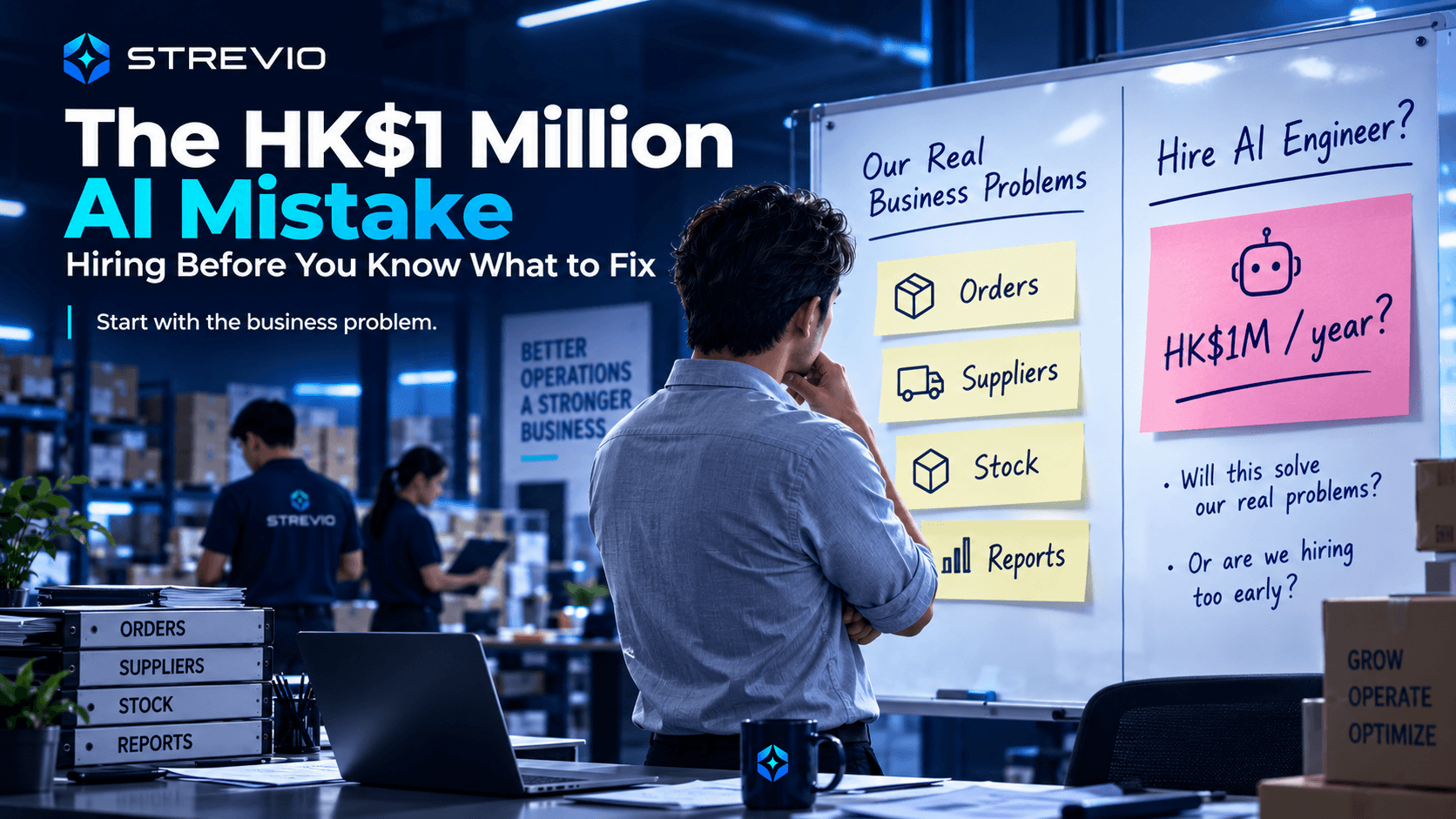
Hiring AI talent can give you more control. It can also give you an expensive team building something nobody actually uses.
In This Article
- The mistake isn't hiring an AI engineer
- You can hire a great engineer and still build the wrong thing
- The people doing the work usually know where the real problems are
- A technically impressive tool nobody uses is still a failed business project
- AI investment is moving faster than business clarity
- "But we want to keep control of our data"
- We have seen the opposite approach work
- Start with the work. Then choose the technology.
- So when does hiring internally make sense?
- Five questions to answer before you hire
- The HK$1 million question
We're going to hire someone internally to handle AI.
We hear this surprisingly often. On the surface, it makes perfect sense. You want more control. You want to protect your company's data. You don't want to depend on an outside provider forever. And if AI is going to become important to the business, why not hire an AI engineer or data analyst and build the capability internally?
There is nothing wrong with that decision. But there is one question you should be able to answer before you post the job advertisement: what exactly are you hiring this person to fix?
- Not "We need AI."
- Not "We need our own model."
- Not "Everyone is doing it."
What actual problem inside the business are you expecting this person to solve? Because a very good engineer working on the wrong problem is still an expensive mistake. And in Hong Kong, it can become a HK$1 million mistake very quickly.
HK$700k–HK$1.3m
annual salary range for a data engineer with 6–10 years of experience in Hong Kong; a data analyst at the same experience level ranges HK$550k–HK$1.1m — before recruitment, benefits, software, infrastructure and management time
Robert Walters 2026 Hong Kong salary data
If the business genuinely needs that capability, spend the money. But don't spend close to HK$1 million just to discover what problem you should have been solving in the first place.
The mistake isn't hiring an AI engineer
The mistake is starting with the technology instead of the business.
Imagine a trading company. The team is constantly chasing suppliers. Someone checks backorders manually. Stock shown in the ERP does not always match the stock the team can actually promise to a customer. Supplier documents arrive by email. Excel is used to rebuild information already sitting somewhere else. Every time the owner wants a clear picture of outstanding orders, someone has to prepare another report. The company is growing, and everybody is busy.
Management looks at the situation and thinks:
We need AI. Let's hire somebody.
But "we need AI" is not a business problem. The problems are:
- Why are people chasing every purchase order?
- Why does answering a customer question require checking three different places?
- Why are people typing information twice?
- Why do managers only discover supplier problems after they have already affected a customer?
- Why does more revenue always seem to require another person?
Those are business problems. Technology should come after you understand them.
You can hire a great engineer and still build the wrong thing
This is not just something we see in SMEs. RAND researchers interviewed experienced data scientists and engineers to understand why AI projects fail.
84%
of industry practitioners interviewed identified leadership-driven causes as a primary reason AI projects fail — most commonly, management asking the technical team to solve the wrong business problem
RAND Corporation
The engineers could work for months and successfully deliver what they had been asked to build. It simply didn't create much value for the business.
RAND also found another interesting problem: 16 of the 50 industry practitioners described situations where technical teams became more interested in using newer tools and technology than in finding the simplest solution to the user's real problem. And 30 of 50 discussed persistent problems with the quality of the company's data.
That should matter to any business owner thinking about hiring internally. The engineer may be excellent. The brief may be nonsense. And if nobody in the business has properly understood the operations, the engineer cannot magically know what matters.
The people doing the work usually know where the real problems are
An operations manager may tell you:
The ERP says we have the stock, but I still need to check before confirming the order.
Your procurement person may tell you:
I have to chase every supplier because otherwise I don't know if the delivery date has changed.
Customer service may say:
I need to ask operations every time a customer wants an update.
Your finance person may have another Excel file because the figures they need are not available in the way they actually use them.
Those details may look boring compared with a management presentation about an "AI strategy." But that is where the business actually operates. Operations are not a PowerPoint diagram. They are hundreds of small checks, decisions, exceptions, emails, spreadsheets, documents and conversations happening every day. And if you don't understand those first, there is a very good chance you will automate something that looks impressive in a demo while the team continues doing the real work exactly as before.
A technically impressive tool nobody uses is still a failed business project
This is where many AI projects go wrong. A company builds an assistant. Or a new dashboard. Or a forecasting tool. Management sees the demonstration and everybody is impressed. Six months later, the operations team is still using Excel.
Why? Because the system was added on top of the business instead of changing the way the work actually gets done.
McKinsey examined 25 different factors associated with companies getting financial value from generative AI. The factor with the strongest relationship to improved financial results was not simply having better technology. It was redesigning how the work itself gets done.
21%
of organizations using generative AI said they had fundamentally redesigned at least some workflows — despite this being the strongest factor linked to improved financial results
McKinsey & Company
~70% / 20% / 10%
of the challenges companies face implementing AI come from people and processes, versus technology and data, versus the algorithms themselves, respectively
BCG
In other words: companies often spend most of their attention on the smallest part of the problem.
AI investment is moving faster than business clarity
There is another reason this happens. Nobody wants to be left behind. AI is everywhere. Competitors are talking about it. Employees are already using it. Boards are asking questions. Management feels it needs to act.
25% / 16%
of AI initiatives had delivered the expected return, while only 16% had scaled across the organization, according to a global CEO survey
IBM
More interestingly, 64% of CEOs admitted that fear of falling behind can push them to invest in technology before they clearly understand the value it is supposed to create.
That is the trap. The conversation becomes:
What should we build with AI?
when it should be:
What is stopping this business from handling more customers, orders and work efficiently?
Those are very different questions.
"But we want to keep control of our data"
That concern is completely legitimate.
64%
of respondents were concerned that sensitive information could accidentally be shared publicly or with competitors through generative AI tools
Cisco 2025 privacy research
43% → 73%
rise in one quarter in the share of leaders citing data privacy and security as the most important consideration when selecting an AI provider
KPMG
So yes, businesses should care about where their information goes. But there is an important distinction: hiring an employee does not automatically give you control of your data. And: owning your data does not mean you need to build your own AI model.
What matters is much more practical.
- Where is your information stored?
- Who can access it?
- What information is allowed to leave your company?
- What gets recorded?
- Who has permission to do what?
- How do you remove access when someone leaves?
- Can you see what the system has done?
Those are decisions about how the system is set up and controlled. They are not solved simply by putting an engineer on your payroll. A company can work with an external specialist while keeping tight control over its information. And a company can employ its own technical team while still having terrible controls.
Data control is a business requirement. Internal hiring is only one possible way of delivering it.
We have seen the opposite approach work
Hong Kong trading company: the ERP was already there
One Hong Kong trading company we worked with already had an ERP. Technology wasn't missing. The problem was what happened around it.
ERP information was exported to Excel. Remaining quantities were recalculated manually. Backorders were checked order by order. Supplier-held stock was reconciled manually. Supplier invoices had to be matched against stock information. The information existed — the team simply had to keep finding it, checking it and rebuilding the answer.
The answer was not to start by building a proprietary AI model. We first understood how the work actually happened. Then the existing ERP, Excel logic, supplier information and documents were connected into a more structured workflow.
Measured Results
- 50–60% less time spent manually rebuilding and maintaining the operational workflow
We did not begin with "What AI should we build?" We began with "What is consuming the team's capacity?"
Read the full International Trading storyWholesale and distribution: restructuring before automating
In another wholesale and distribution operation, the problem was constant procurement tracking, supplier follow-up and fragmented order information.
After restructuring and automating the operational work, the business recorded real change.
Measured Results
- 60% less manual procurement tracking
- More than 3 hours recovered every day
- 35% more orders handled by the same operations team without adding headcount
Start with the work. Then choose the technology.
Read the full Wholesale & Distribution storyStart with the work. Then choose the technology.
The latest research is increasingly pointing in the same direction. In July 2026, BCG reported that although nearly nine in ten CEOs were seeing some AI benefit somewhere in their companies, only 26% had embedded AI into a broader business transformation.
~7x
more likely: companies getting the strongest AI results were roughly seven times more likely to redesign workflows and reshape how the business operates end-to-end
BCG, July 2026
That is a much more useful lesson for an SME than trying to predict which AI model will be best next year.
Understand the business. Understand the work. Understand where capacity is being lost. Then decide what should be automated, what should stay human, what should be connected, what should be bought and what genuinely deserves to be built internally.
So when does hiring internally make sense?
There are absolutely situations where it does.
- If technology is part of what makes your company genuinely different, developing an internal capability can be a very smart investment
- If you have a permanent pipeline of work that justifies a technical team, hiring may make sense
- If you already understand your priority workflows, know what success looks like and need someone continuously improving them, an internal resource can be valuable
McKinsey recently studied AI-focused companies and found a useful principle emerging among them: build what genuinely makes the company distinctive. For internal operational tools, many still use existing solutions rather than building everything themselves. McKinsey also warns that something inexpensive to build today can become expensive to maintain over time.
That is a much better build-versus-buy test than:
We want control, so let's build everything ourselves.
Five questions to answer before you hire
Before committing hundreds of thousands of dollars to an AI or data hire, answer these questions:
- Which operational problem is costing us the most time, money or capacity today?
- What does the team actually do manually to manage that problem?
- What measurable business result should change if we fix it?
- Which systems, spreadsheets, documents and people are involved?
- Do we genuinely need a permanent internal technical capability to solve this, or do we first need to fix and connect the way the business operates?
If you cannot answer the first three clearly, you probably aren't ready to hire yet. Not because AI is wrong for your company. Because you haven't defined what you are buying.
The HK$1 million question
Before you commit close to HK$1 million to internal AI capability, ask yourself: if this person does an excellent job over the next 12 months, what will be visibly better in my business?
- Will the same team handle more orders?
- Will supplier chasing disappear?
- Will reporting stop consuming half a day?
- Will customers get answers faster?
- Will you stop adding admin headcount every time revenue grows?
- Will margins improve?
- Will management regain time?
If you can't describe the answer in business terms, don't start by hiring the engineer. Start by understanding where the business is losing capacity.
AI does not make an unclear business problem clearer. It can simply make it more expensive.
Not Sure Where Your Business Is Losing Capacity?
That's Exactly What This Is For
When you work inside a business every day, inefficient workarounds stop looking like workarounds — they simply become “the way we do things.” That's exactly why we built the STREVIO Free Operational Capacity Assessment: a self-service, 3-minute check with no consultation and no technical knowledge required, giving you a first view of where your business may be losing time, profitability and visibility, and where to look first.
Take the Free Operational Capacity AssessmentFrequently Asked Questions
Should an SME hire an AI engineer?
Sometimes. Hiring internally can make sense when you already have clearly identified business problems, enough ongoing technical work to justify the role and a genuine reason to develop permanent capability inside the company. Hiring first and deciding what the person should solve afterwards is much riskier.
How much does a data engineer cost in Hong Kong?
Robert Walters' 2026 Hong Kong salary data places data engineers with 6–10 years of experience at approximately HK$700,000 to HK$1.3 million per year. More experienced profiles can earn more.
Do we need our own AI model to keep our company data private?
Not necessarily. Controlling company data depends on how your systems are set up, where information is stored, what information is sent externally, who has access and what controls and records are in place. Building your own AI model is one possible technical choice, but it is not the definition of data ownership or privacy.
Is using an external AI partner less secure than hiring internally?
Not automatically. The relevant questions are how information is stored and processed, who can access it, what security controls exist and whether the business retains appropriate control over its data and systems. The employment status of the people building the solution does not, by itself, determine security.
What should we do before investing in AI?
Start with the business. Identify the repetitive work consuming the most capacity, the information people constantly need to chase or rebuild, the processes creating delays and the areas where growth is forcing additional headcount. Then decide what technology is required.
About The Author
Alexandre Besson
Co-Founder & Chief Business Strategist, STREVIO
After more than 20 years running operations across Europe and Asia, Alexandre focuses on helping SMEs remove the manual coordination, information gaps and repetitive work that make businesses harder to run as they grow. STREVIO helps businesses recover Operational Capacity by connecting the systems and information they already use, improving operational visibility and orchestrating workflows so existing teams can handle more business without adding people, cost and complexity at the same rate.