Insights
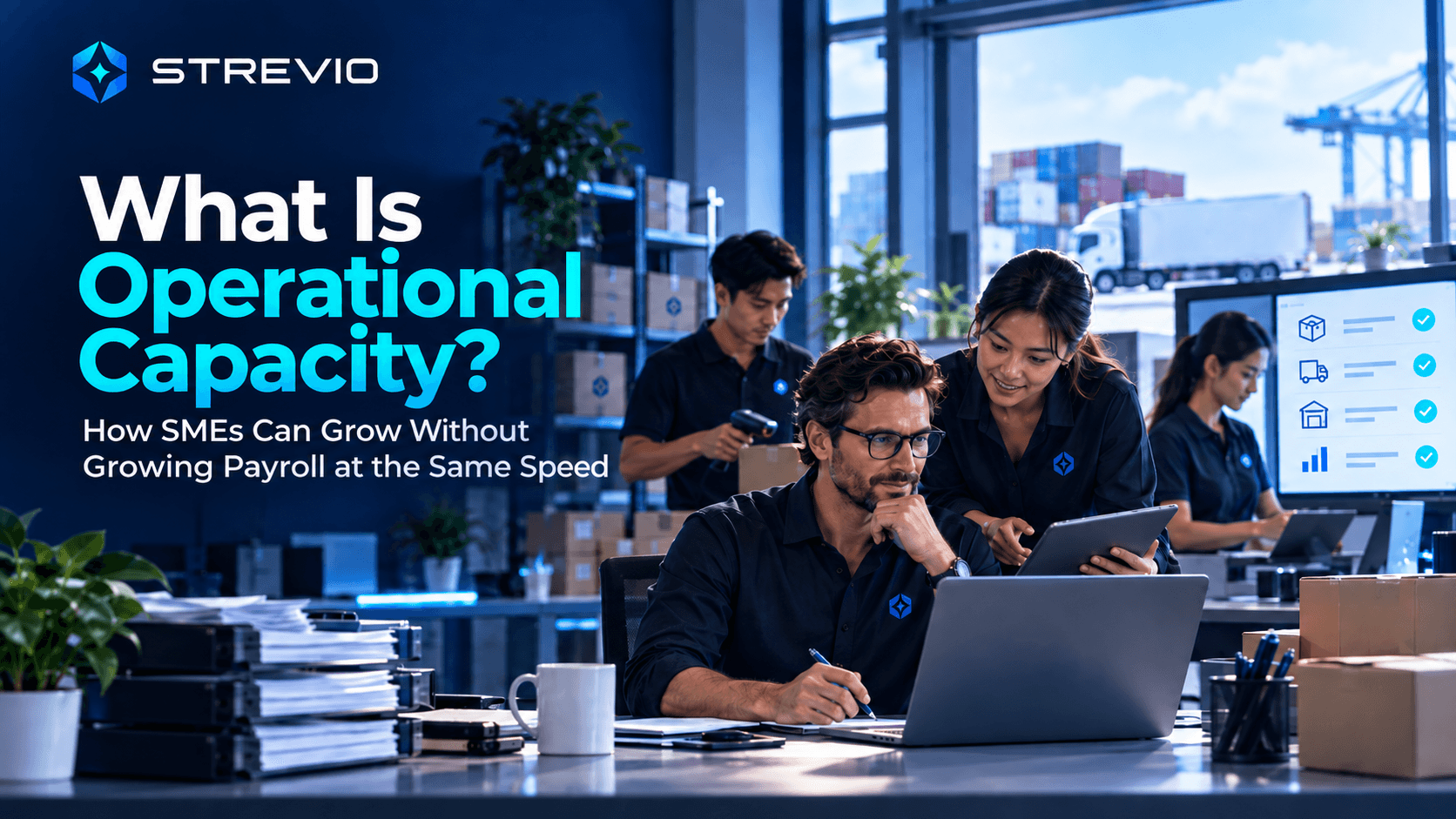
What Is Operational Capacity? How SMEs Can Grow Without Growing Payroll at the Same Speed
Your team may not be out of capacity. Your way of working may be.
In This Article
- What is operational capacity?
- Busy is not the same as full
- Where does operational capacity disappear?
- Why adding people can make the problem bigger
- This is why operational capacity is not the same as efficiency
- Technology helps when it removes work, not when it gives people another screen
- The same warning applies to AI
- So what does increasing operational capacity actually look like?
- What recovered capacity looks like in practice
- How do you know whether capacity is trapped inside your business?
- Measure capacity in language the business understands
- There is nothing wrong with hiring
- Growth should create leverage, not just more work
- The dangerous sentence is: “It still works”
- The best time to recover capacity is before you desperately need it
- Before you add the next salary, understand what you are paying people to do
Your business gets busier.
More customers. More orders. More suppliers. More questions. More things that need checking.
At first, this feels like success. Because it is.
Then something else starts happening.
Reports take longer to produce. Someone is always chasing a supplier. Customer service keeps asking operations for updates. The owner gets copied into more conversations. The same spreadsheet suddenly becomes much more important than anyone intended it to be.
And eventually somebody says:
“We need another person.”
Sometimes they are absolutely right.
If the business genuinely has more valuable work than the current team can reasonably handle, hiring is the correct answer.
But before adding another salary, there is a question worth asking:
If you hired someone tomorrow, what would they actually spend Monday doing?
Would they be serving new customers, negotiating better terms, developing suppliers or managing additional revenue?
Or would they spend a significant part of the day checking spreadsheets, chasing information, updating statuses, rebuilding reports and asking colleagues what is happening?
Those are two very different reasons to hire.
And that difference is what operational capacity is about.
A team can be completely overloaded and still have capacity trapped inside the way it works.
The answer is not to push people harder.
It is to remove work they should never have needed to do in the first place.
What is operational capacity?
Capacity is easy to understand in a factory.
A machine can manufacture a certain number of units per hour.
A warehouse can process a certain number of shipments.
A production line has a maximum output.
But every business has capacity, even when there is no machine to measure.
At STREVIO, we define operational capacity as:
The amount of business your company can reliably handle with the people, systems and processes you already have, without service, control, profitability or the team itself starting to break down.
The word reliably matters.
If your company can handle 30% more business because everybody works until 10 p.m. for three months, you have not created more capacity.
You have borrowed it from your employees.
If revenue increases but errors increase at the same time, that is not healthy capacity either.
If every additional customer generates another chain of emails, another spreadsheet and another question for the owner, growth may be making the company larger without making it stronger.
Operational capacity is therefore not simply another word for efficiency.
It is about how much activity your operating model can absorb.
That includes:
- How quickly information moves
- How much work requires manual coordination
- Whether employees can trust what they see
- How often the same information gets entered twice
- How quickly problems become visible
- How dependent the business is on individual people
- How many decisions need to travel upwards
- How much additional volume your current team can handle before another employee is genuinely necessary
Two companies can employ exactly the same number of people and have completely different operational capacity.
One might need 20 employees to manage 500 orders.
Another might manage 800 with 15.
That does not necessarily mean the second company's employees work harder.
Often, they simply spend less time doing work that should not exist.
Busy is not the same as full
This is where many businesses get capacity wrong.
People are busy, therefore the company assumes it has reached its limit.
But being busy and being at full productive capacity are not the same thing.
Imagine someone working in procurement.
Their real value comes from making sure the company buys the right products, from the right suppliers, at the right price, and that those products arrive when the business needs them.
But their morning might actually look like this.
They check whether a supplier replied overnight.
They ask a colleague whether yesterday's purchase order was updated.
They compare a supplier spreadsheet against the ERP.
Sales asks whether an order will arrive next Thursday.
They search through email for the latest confirmation.
A supplier has not replied, so they chase them again.
They update an internal tracker.
They discover a delivery date changed.
Now sales needs to know.
Customer service needs to know.
The spreadsheet needs updating again.
It is lunchtime.
Nobody was lazy.
Nobody wasted the morning scrolling through Instagram.
Everybody worked.
But how much of that work really required the judgment of an experienced procurement employee?
That is the capacity question.
Microsoft's 2025 Work Trend Index found an uncomfortable contradiction. 53% of leaders said productivity needed to increase, while 80% of workers and leaders reported that they did not have enough time or energy to do their work.
Microsoft's work telemetry also found employees being interrupted by meetings, emails or messages roughly every two minutes during the working day.
So when management says, “We need more productivity,” and employees say, “We are already exhausted,” both sides may be telling the truth.
The problem is not necessarily effort.
The problem may be what all that effort is being spent on.
Where does operational capacity disappear?
Usually, it does not disappear in one spectacular failure.
It leaks away five minutes at a time.
That is why companies tolerate it for years.
Nobody calls an emergency meeting because someone spent eight minutes looking for a supplier email.
Nobody phones the managing director because an employee copied information from Excel into Odoo.
Nobody raises a capital request because customer service had to ask operations a question.
Each event is too small to feel important.
Now multiply it across every employee, every order, every day.
The economics become very different.
There are six patterns we see repeatedly.
1. People spend time searching for information the company already has
This is one of the strangest things in modern business.
Companies have more information than ever.
And employees spend huge amounts of time trying to find it.
The order is in the ERP.
The supplier update is in an email.
The customer's latest request is in the CRM.
The stock figure is in Excel.
Finance has the invoice.
The warehouse knows what physically arrived.
Technically, all the information exists.
Operationally, nobody can see the whole picture.
So people become the connection between the systems.
A customer asks:
“Will my order arrive next week?”
Simple question.
Inside the company, customer service checks the ERP.
The ERP does not have the latest supplier update.
They message purchasing.
Purchasing checks email.
Then they ask the warehouse whether the previous shipment arrived because that affects available stock.
Three employees get interrupted so one person can answer one customer.
The company does not necessarily have an information shortage.
It has an information flow problem.
And people are being paid to compensate for it.
2. The business keeps paying for work it already did once
This is another capacity leak that rarely looks dramatic.
A customer sends information.
Someone enters it into a spreadsheet.
Another employee enters part of it into the ERP.
Finance checks it.
Operations checks it again.
A manager later needs a report, so someone exports the ERP data back into Excel.
Then somebody compares the Excel report against the ERP because nobody is completely sure whether the spreadsheet is current.
Nothing here looks outrageous.
That is exactly why it survives.
Five minutes.
Ten minutes.
Another five minutes.
Multiply those minutes by 300 orders.
Then by twelve months.
Then by every employee touching the process.
Suddenly, a meaningful part of payroll is being spent on work the company already paid for once.
Unfortunately, your P&L does not contain a convenient line called:
“Entering the same information twice: HK$387,000.”
It is hidden inside salaries.
3. Communication becomes the process
Listen to the questions being asked inside the office.
- “Did you send it?”
- “Has the supplier confirmed?”
- “Who is following this?”
- “Can you check the stock?”
- “Did finance approve it?”
- “When is this supposed to ship?”
- “Did the customer reply?”
- “Can you remind me tomorrow?”
Businesses obviously need communication.
I am not suggesting that everyone should sit silently in a room while software runs the company.
But there is a point where communication stops supporting the process and becomes the process.
If ten people need to keep asking each other what is happening, the company has effectively created an invisible coordination department.
Nobody hired it.
Nobody manages it.
Nobody even calls it a department.
It simply consumes part of everybody's working day.
And as the business grows, the amount of coordination usually grows with it.
More customers means more handoffs.
More orders means more status questions.
More employees means more people who need to know what other people did.
That is how companies can add headcount and somehow still feel increasingly overloaded.
4. Small exceptions are discovered after they have become big problems
A supplier promises Monday.
Monday passes.
Nobody notices.
Tuesday passes.
Someone assumes everything is fine.
Wednesday morning, a customer asks for an update.
Now somebody checks.
The supplier says production was delayed.
The goods have not shipped.
Sales gets involved.
Customer service gets involved.
The customer is unhappy.
Management gets involved.
By Wednesday afternoon, five people are discussing a problem that technically existed on Monday morning.
The supplier delay itself may have been unavoidable.
The emergency was not.
Real operations are messy.
Suppliers are late.
Stock is wrong.
Invoices do not match.
Containers move.
Customers change their minds.
You cannot automate reality into behaving perfectly.
Good operations are not about eliminating every exception.
They are about seeing the exception while there is still time to do something useful about it.
There is a huge difference between:
“Shipment delayed. We have eight days to react.”
and:
“Shipment delayed. The customer expected it tomorrow.”
Same problem.
Completely different operational cost.
5. The manager becomes the human API
This one often starts as a strength.
The owner knows everything.
The managing director understands the customers.
The operations manager knows which suppliers can be trusted.
So when people are unsure, they ask.
Reasonable.
Then they ask again.
And again.
A pricing exception comes to management.
Then a delivery question.
Then a stock discrepancy.
Then an approval.
Then a supplier problem.
Then someone asks whether an angry customer should receive a credit.
By lunchtime, the owner has answered twenty questions.
And because the business still works, this can feel like control.
It is not always control.
Sometimes it is simply a queue with the owner standing at the end of it.
A growing business should need more of the owner's judgment.
It should not need more of the owner's availability.
And many of the questions arriving at management are not actually strategic decisions.
The employee cannot see enough information.
They do not trust the number.
They do not know the rule.
Nobody has defined the threshold.
So the safest option is:
“Ask Alex.”
The manager becomes the system that connects all the missing pieces.
That works.
Until there are too many pieces.
6. The process is actually called Sarah
Every SME has at least one person like this.
Ask Sarah.
Sarah knows.
She knows which supplier needs to be chased twice.
She knows that Customer A always orders in a slightly different way.
She knows which number in the ERP can be trusted and which one needs checking first.
She knows which spreadsheet matters.
She knows what happened to that shipment three weeks ago.
This is incredibly useful.
Sarah is valuable.
But there is a problem.
If the process only works because Sarah has been there for nine years and remembers what to do, you do not really have a process.
You have Sarah.
And then Sarah goes on holiday.
Suddenly everyone discovers how much operational infrastructure was stored inside one person's head.
Experienced employees will always have valuable knowledge.
The objective is not to turn people into interchangeable machines.
The objective is to stop the business becoming fragile because basic operational continuity depends on someone's memory.
Why adding people can make the problem bigger
Suppose a ten-person team handles 1,000 orders each month.
At 1,200 orders, everyone starts struggling.
The natural reaction is:
“We need two more people.”
Maybe you do.
But first, understand why the ten existing people reached their limit.
If they spend 30% of their time on manual follow-up, duplicate data entry, reporting, searching for information and avoidable coordination, adding two people does not remove that work.
It gives the work two more employees.
And employees do not only create capacity.
They also create communication.
They need training.
They need information.
They need access to systems.
They ask questions.
They create more handoffs.
They need management.
This is not an argument against hiring.
Good people can create enormous value.
But if your operating model is weak, adding headcount can scale the inefficiency along with the business.
You end up with more employees working very hard inside the same badly designed process.
And everyone wonders why the company grew 30% while management feels twice as busy.
This is why operational capacity is not the same as efficiency
Efficiency usually asks:
Can we do this using fewer resources?
Operational capacity asks:
How much can this business reliably handle?
The difference matters.
Imagine an automation saves an employee one hour every morning.
Great.
Technically, the business is more efficient.
But what happens to the hour?
If that employee can now manage 20 more customer orders, resolve exceptions earlier or spend more time on supplier negotiations, the company has created useful capacity.
If the hour simply disappears into another meeting, more email and more internal administration, the business may have saved time without creating much economic value.
BCG has made a similar point in its research on AI productivity: capacity only becomes valuable when the organization actually redirects it.
That is a useful principle far beyond AI.
Saving time is not the final objective.
The real question is:
What can the business now do that it could not do before?
- Handle more customers?
- Take more orders?
- Delay the next hire?
- Respond faster?
- Make decisions earlier?
- Reduce dependence on the owner?
- Improve margin?
That is when efficiency becomes capacity.
Technology helps when it removes work, not when it gives people another screen
Businesses have invested enormous amounts in software.
ERP.
CRM.
Accounting systems.
Business intelligence.
Collaboration tools.
AI.
And yet some companies still run their daily operation through a combination of Excel, email and somebody remembering what needs to happen next.
The reason is not necessarily that their software is bad.
Each application may be doing exactly what it was purchased to do.
Odoo knows the transaction.
The CRM knows the customer.
Finance knows the invoice.
The supplier has their own information.
The warehouse knows what physically happened.
The problem appears between these systems and people.
This is why buying more software does not automatically create capacity.
Sometimes it simply creates another place to look.
The OECD's 2025 work on SME digitalisation makes a similar distinction. Technology adoption can improve productivity and competitiveness, but businesses also need to adapt their processes around it.
That second part is where many projects struggle.
The company buys a better system.
Then keeps the old spreadsheet.
Keeps the old approval.
Keeps the old email chain.
Keeps the old report.
Keeps the manual check because nobody completely trusts the new process yet.
Six months later, the company has more software and roughly the same work.
That is not transformation.
That is collecting applications.
The same warning applies to AI
AI can make many tasks dramatically faster.
That is real.
It can draft emails.
Summarize documents.
Extract information.
Analyze text.
Prepare reports.
Help employees find answers.
But we need to distinguish between making a task faster and removing the reason the task existed.
Suppose an employee manually chases twenty suppliers every week.
AI can write twenty follow-up emails faster.
Useful.
But there is another question:
- Why is someone manually checking twenty suppliers in the first place?
- Could the business already know which suppliers failed to confirm?
- Could it identify which orders are actually at risk?
- Could normal confirmations flow automatically while employees focus only on exceptions?
Those are different levels of improvement.
One makes the existing task faster.
The other changes the work.
McKinsey's research into generative AI found that workflow redesign had the strongest relationship with EBIT impact among the organizational practices it studied.
Yet in its 2025 research, only 21% of organizations using generative AI said they had fundamentally redesigned at least some workflows.
Later research found AI high performers were much more likely to have redesigned workflows, 55% compared with 20% among other respondents.
The lesson for an SME is not that you need a giant AI strategy.
You probably don't.
The lesson is simpler.
Do not automate a stupid process just because you can automate it.
Understand why the work exists first.
Then decide what should disappear, what should change and what still needs a human being.
So what does increasing operational capacity actually look like?
Usually, it is not a dramatic transformation project.
It is a series of practical changes.
At STREVIO, we think about it through four stages.
See what is happening
- Can the right people see what is happening in the business without reconstructing it manually?
- What is late?
- What has changed?
- What is blocked?
- Which order needs attention?
- Where is stock?
- Where is margin moving?
- What is likely to become a problem?
Visibility sounds simple.
It is not.
A company can contain all the data it needs and still lack operational visibility because the information is spread across different places.
When people stop spending hours rebuilding reality, capacity comes back.
Understand what matters
More information is not automatically better.
Nobody needs another dashboard with 64 numbers.
The objective is to understand what requires attention.
- Why did margin fall?
- Why is the order delayed?
- Which customers are affected?
- Is the stock actually available?
- Is the exception important enough to escalate?
- Which supplier requires action today?
A dashboard nobody understands is decoration.
A dashboard nobody trusts is worse.
Good operational information reduces questions.
It should not create another meeting to explain the dashboard.
Remove repetitive work
Once the business understands the workflow, repetitive activity becomes easier to identify.
Status updates.
Recurring reports.
Data movement.
Matching documents.
Checking whether a condition has changed.
Routine reminders.
Standard approvals.
There is nothing noble about making talented employees perform these tasks manually forever.
Your good people should not spend their careers moving information from Column B into Screen C.
Use people where judgment, negotiation, relationships and problem-solving matter.
Use technology where repetition does not.
Make the next action easier
This is where many improvement projects stop too early.
The dashboard says:
ORDER LATE.
Excellent.
- Now what?
- Who needs to know?
- What information do they need?
- Does the system create an action?
- Can the employee solve it themselves?
- Does management actually need to approve?
- Can a normal situation continue without someone touching it?
Operational capacity increases when the business gets better at moving from information to action.
Another dashboard is not the goal.
A better operating business is.
What recovered capacity looks like in practice
The concept becomes much easier to understand when we look at actual operations.
The examples below are individual STREVIO client results. They are not universal benchmarks, but they show what recovering operational capacity can look like when unnecessary work is removed.
Wholesale and distribution
In one wholesale and distribution operation, a significant amount of the procurement team's day was consumed by tracking purchase orders, chasing suppliers, checking confirmations, monitoring backorders and updating customer commitments.
None of this work was imaginary.
The business genuinely needed the answers.
The problem was that employees repeatedly had to find those answers manually.
After improving visibility and reducing manual follow-up, the business recorded approximately 60% less procurement and supplier-tracking work.
More than three hours per day were recovered.
And the same team was able to handle approximately 35% more orders.
Notice what did not happen.
Employees did not suddenly type 35% faster.
The company removed work.
That is the difference.
Food import and distribution
A food-import business faced another common problem.
Inventory information required repeated checking and reconciliation.
Management reporting also consumed a significant amount of employee time.
Again, the employees were not inefficient people.
They were compensating for an operating model that made reliable information unnecessarily difficult to produce.
After changing how the information moved, manual reporting fell by around 80%.
Inventory reconciliation became roughly 50% faster.
And the same team was able to handle approximately 30% more orders.
The value was not the dashboard.
The value was what the team could do once it no longer spent so much time building the dashboard.
Manufacturing
In a manufacturing operation, too much coordination between people and processes was being handled manually.
Changes needed chasing.
Reporting was slow.
Employees were acting as messengers between different parts of the operation.
After improving the operating flow, manual coordination fell by approximately 70%.
Reporting became around 80% faster.
And throughput increased by roughly 35% without increasing administrative headcount.
Different company.
Different problem.
Same principle.
When people stop spending time compensating for broken information flow, the business gains room to do more.
How do you know whether capacity is trapped inside your business?
You do not need a six-month consulting project to start finding out.
Watch what people actually do.
Not what the organization chart says they do.
Not what their job description says.
Their actual day.
Ask questions like:
- How many hours every week are spent preparing recurring reports?
- How often does someone type information that already exists somewhere else?
- How many customer questions require another department to answer?
- How much time is spent checking what happened instead of deciding what happens next?
- How many supplier problems are discovered because someone happened to remember to ask?
- How many questions arrive on the owner's desk every day?
- What stops working when one experienced employee goes on holiday?
- How many spreadsheets exist because the core system does not give people what they need?
- How many messages are required to move one normal order through the business?
And one question I particularly like:
If volume increased 30% next month, what would break first?
The answer tells you a lot.
- Would sales struggle?
- Would purchasing drown in follow-up?
- Would customer service lose visibility?
- Would reporting collapse?
- Would the owner become the bottleneck?
- Would you immediately need three more employees?
That is where your operational-capacity constraint probably lives.
Measure capacity in language the business understands
Operational capacity should not become another management concept with a complicated score nobody looks at.
Measure things that matter.
Orders handled per employee
Can the same team reliably handle more activity without increasing mistakes, overtime or customer complaints?
If yes, capacity probably increased.
Manual effort per order
How much human activity does one transaction require?
This is often more revealing than total employee hours.
Reporting effort
How many hours are spent turning business activity into management information?
If a report that took half a day now takes five minutes, that capacity has been recovered.
Follow-up volume
How many emails, calls and internal messages are required simply to keep normal work moving?
If normal operations need constant chasing, something is expensive underneath.
Exception response time
How quickly does the company notice something abnormal?
The earlier an exception becomes visible, the cheaper it usually is to manage.
Rework
How much time is spent correcting previous work?
Yesterday's mistakes consume tomorrow's capacity.
Management interruptions
How often does the owner or senior management need to step into routine operations?
If management becomes the default escalation route, that is not just a leadership problem.
It is a capacity problem.
Volume before the next hire
For a growing SME, this is often one of the most useful measures.
If a business expected to hire another operations employee at 1,000 orders but can now comfortably reach 1,300, that extra headroom has real financial value.
The point is not to avoid the hire forever.
The point is to hire when the business genuinely needs additional productive capacity.
There is nothing wrong with hiring
This is worth saying clearly.
Sometimes the answer really is:
Hire another person.
You need expertise the company does not have.
Demand has structurally increased.
You are entering a new market.
Customer-facing capacity genuinely needs to expand.
The team has already removed unnecessary work and the remaining workload still requires human attention.
Perfect.
Hire.
There is no trophy for running the business with the smallest possible number of employees.
And there is no prize for automating everything simply because AI exists.
The objective is not minimum payroll.
The objective is to make sure the payroll you choose to carry is producing as much useful capacity as reasonably possible.
Good people are expensive.
That is exactly why they should not spend half the day compensating for poor information flow.
Growth should create leverage, not just more work
Healthy growth should give a business some leverage.
Of course, costs rise.
More customers may need more service.
More products require more purchasing.
More shipments need handling.
Some departments will need to grow.
But if revenue increases 50% and the company immediately needs:
- 50% more administration
- 50% more internal coordination
- 50% more reporting effort
- 50% more management intervention
- 50% more people chasing information
it is worth asking whether the operating model is really scaling.
You may be increasing the size of the business.
But you may simply be reproducing the same inefficiencies at a larger scale.
A better operating model allows parts of the company to absorb more activity before cost needs to rise.
That gap is leverage.
And for many SMEs, increasing operational capacity is one of the most accessible ways to create it.
The dangerous sentence is: “It still works”
Most businesses do not improve their operations because everything collapsed.
They improve them because they eventually realize how much effort it takes to keep everything from collapsing.
There is an important difference.
The spreadsheet works.
The report eventually arrives.
Sarah knows what to do.
The owner answers the question.
The supplier gets chased.
The customer receives an explanation.
Technically, yes.
It works.
But “it works” is a very low standard for an operating model.
The better question is:
What is it costing you to make it work?
- How much employee time?
- How much management attention?
- How much margin?
- How much unnecessary hiring?
- How much frustration?
- How much capacity for future growth?
Businesses often tolerate inefficient operations because the cost is distributed across hundreds of small activities.
There is no invoice arriving at the end of the month saying:
Cost of keeping the current way of working: HK$76,420.
So doing nothing feels free.
It isn't.
The best time to recover capacity is before you desperately need it
At 200 orders, the spreadsheet is manageable.
At 500, people complain.
At 800, the person maintaining it becomes essential.
At 1,200, management announces that the company has an operational problem.
The problem probably existed at 200.
The volume simply made it impossible to ignore.
The same happens with owner dependency.
Supplier chasing.
Reporting.
Inventory reconciliation.
Manual approvals.
Duplicate entry.
Bad processes can survive for years when volume is low.
Growth exposes them.
That is why the right time to improve operational capacity is usually not when the business is on fire.
It is when management starts seeing the smoke.
Before you add the next salary, understand what you are paying people to do
When your team says it needs another employee, do not automatically disagree.
And do not automatically agree.
Look at the work.
What will the new person actually do?
Will they:
- Serve additional customers
- Manage new revenue
- Negotiate better outcomes
- Solve problems requiring judgment
- Create capabilities the company does not have?
Good.
That sounds like capacity.
But if a significant part of the role will be:
- Chasing
- Copying
- Checking
- Rebuilding
- Reminding
- Searching
- Coordinating
look at the process first.
You may still decide to hire.
But at least you will know what you are buying.
Because:
You do not recover operational capacity by asking already-busy people to work harder. You recover it by removing work they should never have been doing in the first place.
And once that happens, the question changes.
Instead of asking:
“How many more people do we need?”
you can finally ask:
“How much more business can the company we already built actually handle?”
That is operational capacity.
Not Sure Where Your Business Is Losing Capacity?
That's Exactly What This Is For
When you work inside a business every day, inefficient workarounds stop looking like workarounds — they simply become “the way we do things.” That's exactly why we built the STREVIO Free Operational Capacity Assessment: a self-service, 3-minute check with no consultation and no technical knowledge required, giving you a first view of where your business may be losing time, profitability and visibility, and where to look first.
Take the Free Operational Capacity AssessmentFrequently Asked Questions
What does operational capacity mean in a business?
Operational capacity is the amount of business an organization can reliably handle with its existing people, systems and processes before service quality, profitability, control or employee workload begin to deteriorate. For an SME, that could mean orders processed, customers served, shipments managed, transactions completed or projects delivered.
Is operational capacity the same as productivity?
No. Productivity generally measures how much output is produced from a given amount of input. Operational capacity describes how much activity the overall business can reliably absorb. Improved productivity can increase operational capacity, but only if the capacity that has been freed is used productively.
How do I know whether my business has reached its operational capacity?
Warning signs can include increasing overtime, constant supplier or customer follow-up, slow reporting, growing reliance on spreadsheets, repeated mistakes, management becoming involved in routine questions and every increase in activity appearing to require another employee. However, those symptoms do not always mean the company has genuinely reached its capacity. They may mean existing capacity is being consumed by inefficient workflows.
Can a business increase capacity without hiring more employees?
Yes. Businesses can often increase capacity by reducing duplicate work, improving information flow, automating repetitive activities, identifying exceptions earlier and reducing unnecessary coordination. This does not mean the company will never need additional employees. It means headcount does not necessarily need to increase at exactly the same rate as operational volume.
How can automation increase operational capacity?
Automation can remove repetitive work such as data entry, recurring reporting, reminders, status checks, information matching and routine workflow updates. The strongest gains usually occur when automation improves the process itself rather than simply making one existing task faster.
Does an ERP automatically increase operational capacity?
No. An ERP can provide an excellent transactional foundation, but employees may still rely on spreadsheets, email and manual work to connect processes across departments, suppliers, customers and other systems. Operational capacity increases when information becomes easier to use and unnecessary work around the ERP is removed.
When should a growing company hire instead of automate?
Hiring makes sense when demand has genuinely exceeded productive capacity, when the company requires expertise it does not currently have, or when the remaining work genuinely requires human judgment, interaction or specialist skills. Before hiring specifically to absorb more administrative or coordination work, it is worth understanding whether some of that workload can be removed first. The objective is not to avoid hiring. It is to make sure new employees add capacity instead of compensating for unnecessary work.
About The Author
Alexandre Besson
Co-Founder & Chief Business Strategist, STREVIO
After more than 20 years running operations across Europe and Asia, Alexandre focuses on helping SMEs remove the manual coordination, information gaps and repetitive work that make businesses harder to run as they grow. STREVIO helps businesses recover Operational Capacity by connecting the systems and information they already use, improving operational visibility and orchestrating workflows so existing teams can handle more business without adding people, cost and complexity at the same rate.