
Insights
What Is Operational Leakage? Where Time, Margin and Capacity Disappear Inside a Growing Business
Most businesses know what they spend. Far fewer know what their way of working costs.
In This Article
- What is operational leakage?
- Operational leakage is expensive precisely because most of it looks like normal work
- Your P&L shows what your people cost. It does not show what their day costs.
- Where does operational leakage actually happen?
- Labour leakage: paying people to do work the business already did
- Information leakage: the answer exists, but nobody can get to it easily
- The phrase worth paying attention to is: “Ask…”
- Process leakage: when the gaps between tasks cost more than the tasks themselves
- A bad process can be executed perfectly
- Margin leakage: when operational friction stops being invisible
- “Pretty good” can still produce an expensive result
- Management leakage: when expensive people become part of the infrastructure
- “Ask the boss” is not always a delegation problem
- Capacity leakage: when all the small problems finally show up as another salary
- How much can operational leakage cost?
- A profitable business can still leak badly
- More technology does not automatically plug the leaks
- Sometimes the new tool becomes another leak
- How do you measure operational leakage without turning it into a consulting circus?
- Frequency matters more than whether a task takes eight minutes or eleven
- Not every leak needs a dollar sign attached immediately
- You can learn a surprising amount in one week
- What should you fix first?
- What happens when leakage is reduced?
- You do not need to eliminate every leak
- The most expensive leaks are often the ones nobody notices anymore
- Growth multiplies whatever operating model you already have
- Your process never sends you an invoice
- Before buying more capacity, look at the capacity you are already losing
Your business can be profitable, growing and well managed while leaking money every single day.
Not because somebody is stealing.
Not because your accountant missed something.
And not because your employees are lazy.
The money disappears in much more boring ways.
Someone spends twenty minutes finding an answer the company already has.
Another employee enters information somebody else entered yesterday.
A supplier delay is discovered three days too late, so you pay for air freight.
A customer receives a discount because nobody can confidently explain what happened.
Finance corrects an invoice.
Operations checks the correction.
A manager spends an hour solving something that should never have reached them.
None of these things will bankrupt you this afternoon.
That is exactly why they are dangerous.
They happen quietly.
They look like normal work.
And because everybody is busy, nobody stops to ask what all this activity is actually costing.
This is operational leakage.
And it is not only about wasted time.
It can leak labour, margin, speed, management attention, control and ultimately the capacity of the business itself.
That is why it deserves more attention than another generic conversation about “efficiency.”
What is operational leakage?
At STREVIO, we use operational leakage to mean:
The avoidable loss of time, margin, speed, control or capacity caused by the way work moves through a business.
It is not an accounting standard.
You will not find an internationally agreed line on your financial statements called “Operational Leakage.”
That is partly the problem.
A business knows its salary bill.
It knows how much it spends on rent.
It knows the cost of freight.
It knows what its ERP costs.
It knows how much it pays suppliers.
Those expenses arrive with numbers attached.
The cost of the way the business operates is much harder to see.
- How much does it cost when employees cannot find information?
- How much when the same information is entered twice?
- How much management time disappears answering routine operational questions?
- What does a late decision cost?
- How much margin disappears through credits, errors, emergency freight and avoidable discounts?
- How many employees are hired earlier than necessary because the people already there spend part of the week compensating for weak processes?
Very few companies can answer all of those questions.
That does not make the cost imaginary.
It simply makes it hidden.
Operational leakage is expensive precisely because most of it looks like normal work
Imagine one employee spent four hours every morning doing absolutely nothing.
Management would notice.
If somebody accidentally transferred HK$50,000 to the wrong supplier every month, somebody would notice that too.
Operational leakage is harder to spot because the employee is actually working.
They are answering emails.
Updating spreadsheets.
Checking orders.
Calling suppliers.
Preparing reports.
Looking for documents.
Fixing mistakes.
Attending meetings.
Escalating problems.
Nobody is sitting around doing nothing.
In many cases, the employee is working extremely hard.
The problem is that part of the work exists only because of the way the business currently operates.
That distinction matters.
Suppose somebody spends ten minutes every morning transferring information from one system into another.
Ten minutes.
Who cares?
There are bigger problems in business.
But ten minutes every working day becomes more than forty hours a year.
Now multiply that by several employees.
Add the weekly report someone rebuilds manually.
Add stock reconciliation.
Supplier follow-ups.
Customer status questions.
Invoice corrections.
Management approvals.
The five-minute checks.
The ten-minute fixes.
The information people spend fifteen minutes trying to find.
Suddenly, we are not talking about ten minutes anymore.
We are talking about part of your payroll.
There is simply no invoice for it.
Your P&L shows what your people cost. It does not show what their day costs.
This is one reason operational leakage survives for years.
Your accountant can tell you payroll was HK$4 million last year.
Useful.
But the accounts will not normally tell you how much of that payroll went into moving information between systems.
Or searching for answers.
Or rebuilding reports.
Or correcting preventable errors.
Or having senior people answer questions that should never have reached them.
Quality-management professionals have dealt with a similar issue for decades through the concept of Cost of Poor Quality.
The American Society for Quality points out that the cost of failure extends well beyond obvious defects. Some costs are difficult to capture precisely because they never hit a formal account: informal rework, expedited shipments, firefighting and lost customer goodwill can all consume real resources while being booked simply as normal operating expense. (The American Society for Quality (ASQ))
Operational leakage is broader than Cost of Poor Quality.
But the underlying principle is useful:
A cost does not need its own accounting code to be real.
That sounds obvious.
Yet businesses routinely negotiate a 2% supplier increase while ignoring hundreds of employee hours lost inside a process nobody has questioned for five years.
Visible costs get attention.
Hidden costs get absorbed.
Where does operational leakage actually happen?
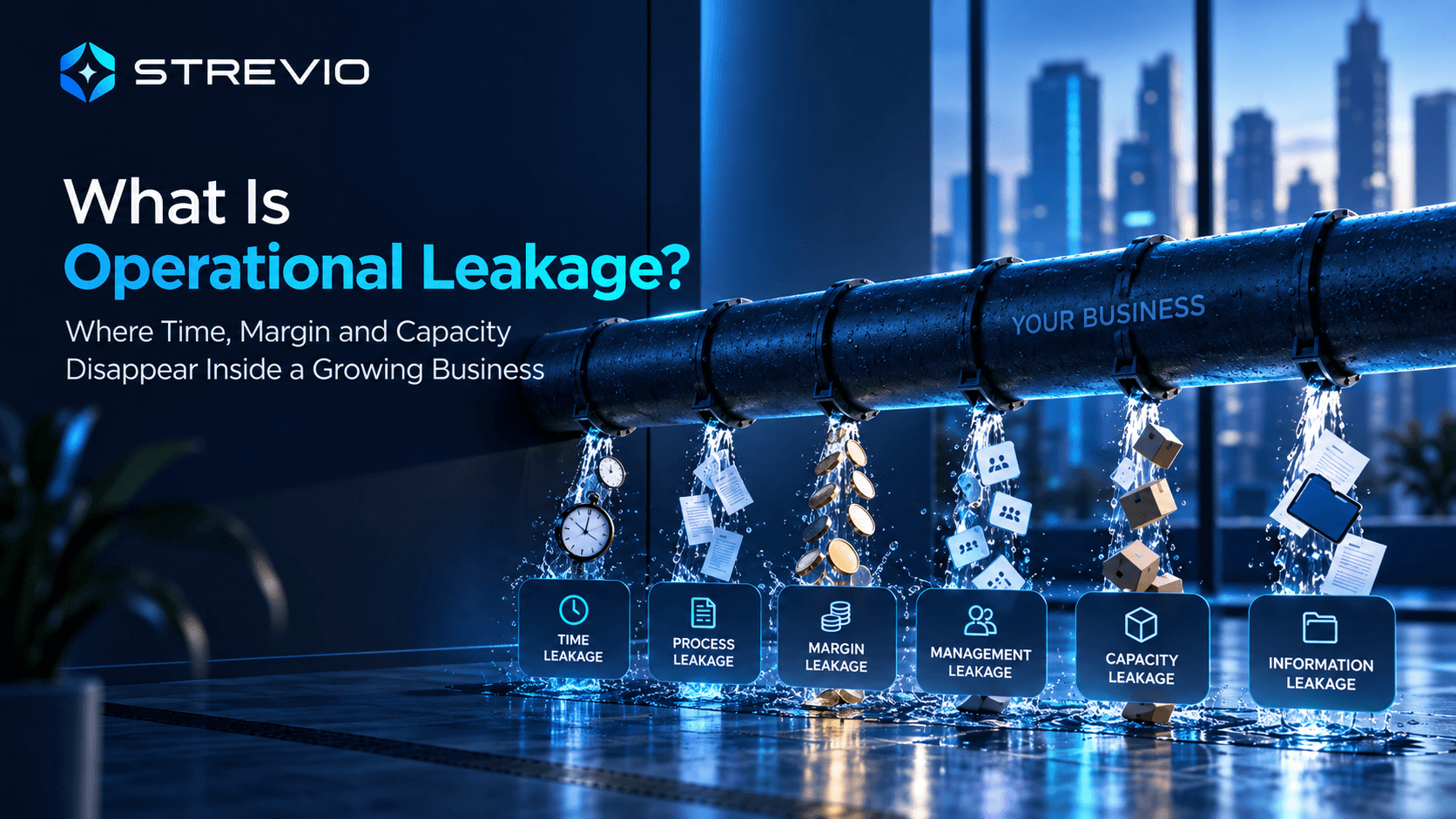
You can think about it through six areas: labour, information, process, margin, management and capacity.
They are connected.
A problem may begin as information leakage, create labour leakage, eventually cause margin leakage and finally reduce the capacity of the entire business.
That chain is important.
Because operational leakage is not simply “people wasting time.”
Sometimes the employee time is the smallest part of the cost.
Labour leakage: paying people to do work the business already did
Start with a familiar situation.
A supplier sends a document.
An employee downloads it.
They copy information into Excel.
Then part of the same information goes into the ERP.
Finance later checks the ERP against the supplier document.
At the end of the week, someone exports data from the ERP back into Excel to prepare a management report.
Another employee checks the spreadsheet because nobody is entirely confident that everything has been updated.
How many times did the company pay to touch the same information?
Nobody behaved badly.
That is what makes this interesting.
Every individual step may make complete sense inside the current process.
But step back.
The company received the information once.
Then paid multiple people to move it, check it, reconstruct it and explain it.
That is labour leakage.
It happens when someone manually prepares the same report every Monday.
When twenty routine supplier reminders are written individually.
When employees repeatedly check whether statuses have changed.
When invoices are downloaded, renamed and filed manually.
When sales information is copied into another operational tracker.
When employees match documents that could be matched automatically.
When someone creates a management summary because the underlying information is too difficult to understand directly.
Some of these tasks genuinely require a person.
Many do not.
The point is not to look at an experienced employee spending two hours a day on administrative work and say:
“Work faster.”
The better question is:
Why are we paying an experienced employee to do this at all?
The employee may be excellent.
The work may not be.
Information leakage: the answer exists, but nobody can get to it easily
Modern companies have enormous amounts of information.
And apparently, we have become very good at storing information in places nobody can find.
Atlassian's 2025 State of Teams research surveyed 12,000 knowledge workers and 200 executives and found teams losing about 25% of their time searching for answers. Separate Atlassian research found 56% of workers said they often needed to ask another person or schedule a meeting simply to obtain the information they needed. (Atlassian)
Think about that for a moment.
Companies have never had more data.
Yet employees still need to ask:
“Where is it?”
The problem is not necessarily a lack of information.
It is that storing information and making it operationally useful are two different things.
The ERP contains the order.
Email contains the supplier update.
The CRM contains the customer conversation.
WhatsApp contains something important someone sent yesterday.
Excel contains the latest reconciliation.
Finance knows about the credit.
The warehouse knows what physically arrived.
Then the customer asks:
“Where is my order?”
One question.
Several systems.
Two colleagues.
Fifteen minutes.
From the customer's perspective, they bought from one company.
Inside the company, five sources of information are trying to reconstruct one answer.
Every time someone has to interrupt another employee to find something, the leakage spreads.
One person's information problem becomes two people's lost time.
Then perhaps three.
That is how something as innocent as “Can you check this for me?” becomes expensive at scale.
The phrase worth paying attention to is: “Ask…”
Ask purchasing.
Ask finance.
Ask Sarah.
Ask the warehouse.
Ask Alex.
Ask the supplier.
Obviously people should communicate.
The objective is not to create an office where nobody speaks because management decided conversation was inefficient.
The issue is when access to routine information depends on knowing which person to interrupt.
If the fastest way to understand an order is to find the employee who already understands it, you have built a human search engine.
At small scale, this works remarkably well.
Then the company grows.
Ten questions become thirty.
Thirty become sixty.
The knowledgeable employee becomes indispensable.
Everyone says:
“We couldn't run the business without Sarah.”
Sometimes that is a compliment.
Sometimes it should make you nervous.
Process leakage: when the gaps between tasks cost more than the tasks themselves
A lot of process leakage happens while nobody appears to be doing anything wrong.
Waiting for approval.
Waiting for information.
Waiting because someone has not checked something.
Waiting until the weekly meeting.
Waiting because nobody knows whose responsibility it is.
Waiting for the owner.
Then come the handoffs.
Sales sends something to operations.
Operations sends something to purchasing.
Purchasing goes back to sales.
Finance asks operations.
Operations asks the warehouse.
The warehouse sends something back to finance.
Every handoff has a cost.
Not just the minute required to send the message.
It creates another opportunity for delay, misunderstanding, lost context or forgotten action.
Then there are duplicate steps.
Someone reviews something that was already reviewed.
A manager approves routine transactions because “we've always required approval.”
An employee updates a tracker to confirm that the ERP was updated.
Someone prepares a report, then another person checks the report against the system it came from.
Each activity is small.
And that is precisely why small operational costs survive.
Individually, they rarely look worth fixing.
Collectively, they can become a way of running the entire company.
A bad process can be executed perfectly
This is an important distinction.
When something takes too long, management often looks at the employee.
- Could they be quicker?
- Could they organise themselves better?
- Could we give them another KPI?
Sometimes, yes.
But people can execute a bad process perfectly.
Imagine every purchase order requires three approvals.
Everyone responds quickly.
Nobody forgets.
The process works exactly as designed.
Excellent.
But if 90% of those approvals have never changed the outcome, the important question is not:
“How do we get approvers to respond even faster?”
It may be:
“Why are we asking them?”
Improving a person might save two minutes.
Removing an unnecessary step can save the step forever.
That is a very different kind of improvement.
Margin leakage: when operational friction stops being invisible
Eventually, some leakage turns into actual money.
A supplier delay is discovered late.
Now you pay for air freight.
Stock information is wrong.
Sales promises something that cannot be delivered.
Now you offer the customer a discount.
An invoice is incorrect.
Payment gets delayed.
A shipment is incomplete.
Finance processes a credit.
Documentation is wrong.
The customer rejects part of an order.
The expected product margin looked good, but extra freight, supplier charges or other landed costs were never properly reflected.
The order was profitable on the spreadsheet.
Reality had other ideas.
The interesting part is that the financial consequence often appears somewhere completely different from the operational cause.
The freight invoice does not say:
“You are paying this because nobody noticed the supplier delay on Tuesday.”
The customer credit does not say:
“This discount exists because sales made a commitment using outdated information.”
Finance sees the cost.
Operations experienced the cause.
Management may never connect the two.
This is where operational leakage becomes particularly dangerous.
The business knows it lost money.
It just does not always know where the loss really began.
“Pretty good” can still produce an expensive result
KPMG's 2026 work on Perfect Order Performance illustrates this extremely well.
A company can look healthy across individual metrics such as on-time delivery, order completeness, billing accuracy, documentation and damage-free fulfilment.
But customers experience the complete order, not five separate KPI dashboards.
If five different order dimensions each perform correctly 95% of the time, the compounded perfect-order rate is only about 77%.
In other words, nearly one in four orders can still experience some failure even though every individual metric looks “pretty good.” KPMG notes that those failures can lead to premium freight, rework, returns, credits, delayed payment, customer-service escalations and margin pressure. (KPMG)
That is a useful lesson far beyond logistics.
Businesses are systems.
One small weakness might be harmless.
Several small weaknesses touching the same transaction can become expensive.
And this is why looking at departments individually often hides operational leakage.
Purchasing might look fine.
Logistics might look fine.
Finance might look fine.
Customer service might look fine.
Meanwhile the customer order travelling between them is creating rework in all four.
Management leakage: when expensive people become part of the infrastructure
This may be one of the least measured forms of operational leakage.
The owner spends twenty minutes resolving a stock problem.
No invoice.
The managing director helps explain a customer issue.
No invoice.
The operations director reconciles two conflicting reports because nobody trusts either one.
No invoice.
A senior manager spends an hour before a meeting chasing people because the KPI report is incomplete.
Still no invoice.
Management time disappears easily because senior people are supposed to help.
And of course they should.
The problem is when helping becomes part of the operating model.
The owner knows which number is correct.
The manager knows which supplier to call.
The director knows why the order is late.
Everybody else depends on them.
This can look like strong control.
Sometimes it is.
But if highly paid people regularly spend time connecting information, checking statuses and resolving basic process gaps, the company is using expensive judgment to compensate for operational problems that should cost much less to solve.
There is also an opportunity cost.
Every hour the owner spends reconstructing what happened to an order is an hour not spent on customers, pricing, partnerships, recruitment, expansion or thinking about where the business goes next.
Management attention is finite.
Leak enough of it into daily operations and eventually leadership becomes another overloaded department.
“Ask the boss” is not always a delegation problem
This deserves a distinction.
An owner can trust their team completely and still become an operational bottleneck.
Employees do not necessarily escalate because management refuses to delegate.
Sometimes they escalate because the information is unclear.
The numbers conflict.
Nobody knows the rule.
The exception does not fit the normal process.
There is no defined threshold.
Or the consequence of making the wrong decision feels too large.
So they ask the boss.
That can be perfectly rational.
If the business has not made the right information and decision rules available, escalation is often the safest option.
Telling management simply to “delegate more” misses the point.
The better question is:
Why did this decision need to travel upwards at all?
Some answers genuinely require senior judgment.
Many do not.
Capacity leakage: when all the small problems finally show up as another salary
Eventually the other forms of leakage combine.
Employees are busy.
Managers are busy.
Volume is rising.
Reports are taking longer.
Follow-up increases.
Errors increase.
Everybody says the company is stretched.
Then somebody says:
“We need another person.”
They may be right.
But if part of the team's week is still being consumed by searching, duplicate work, manual coordination, rework and reporting, the company may not have exhausted its productive capacity.
It may simply have exhausted its ability to absorb the leakage.
That distinction matters.
Because the next hire may be necessary eventually.
But when you need that person can materially affect the economics of growth.
If better operations allow the same team to absorb another six or twelve months of volume before the hire becomes necessary, that recovered headroom has financial value.
And when the new employee eventually joins, they enter a stronger business rather than becoming another person paid to compensate for the same old problem.
That is when operational leakage becomes capacity leakage.
The business reaches its apparent limit earlier than it should.
How much can operational leakage cost?
There is no honest universal percentage.
If someone has never seen your company but confidently tells you:
“Operational leakage is costing you exactly 17.4%,”
be careful.
Different companies have different margins, labour structures, processes, systems and complexity.
But there is evidence that these inefficiencies can become financially material.
A 2026 UKG study of 1,400 global organisations with at least 1,000 employees estimated that workforce-operation inefficiencies were draining roughly 2% to 4% of annual revenue, with administrative burden, error-prone manual work, limited visibility and fragmented information among the causes. (UKG)
Those were very large companies, with average revenue around £1.2 billion.
So we should absolutely not take that percentage and casually apply it to a 20-person trading company in Hong Kong.
That would be nonsense.
But the study demonstrates something useful:
Operational inefficiency can become economically large enough to measure in percentage points of revenue.
What matters is discovering the number, or at least the pattern, inside your own business.
A profitable business can still leak badly
Operational leakage does not mean a company is failing.
That is another reason people underestimate it.
A profitable business can leak.
A fast-growing business can leak.
A company with fantastic employees can leak.
In fact, growth can hide the problem for quite a long time.
Revenue rises.
Customers keep buying.
Another employee joins.
Then another.
Profit still increases.
Everyone is busy.
Nothing looks broken.
Suppose revenue grows 25% and payroll grows 30%.
That might still produce an excellent business.
But what if part of the additional headcount exists only because the company never fixed its supplier follow-up, reporting and duplicate data entry?
Nobody necessarily notices.
The business made money.
And successful companies are understandably reluctant to interfere with something that appears to be working.
Sometimes the company succeeds because of the operating model.
Sometimes it succeeds despite it.
Those are very different situations.
Growth eventually tells you which one you have.
More technology does not automatically plug the leaks
There is an obvious response to all of this:
Buy better software.
New ERP.
Better CRM.
Another dashboard.
AI.
Automation.
Technology can absolutely reduce operational leakage.
But only when it changes the way the work moves.
A company can implement an ERP and keep the spreadsheet.
Implement a CRM and keep customer information in personal WhatsApp conversations.
Build a dashboard and keep producing the old manual report because management does not trust the dashboard.
Give everyone AI and keep the same broken workflow, except now employees can write the chasing emails faster.
The OECD's 2026 D4SME Survey covered more than 2,000 SMEs across 12 OECD countries. It found AI adoption increasing quickly, but strategic, targeted and secure integration into business operations remained uneven, with time constraints, maintenance costs and skills gaps still limiting effective implementation. (OECD) The important word is integration.
Buying technology is relatively easy.
Removing unnecessary work is harder.
Sometimes the new tool becomes another leak
This does not get discussed enough.
The company has a problem.
So it buys a tool.
Now there are two systems.
They do not communicate perfectly.
So someone exports information into Excel.
Another department needs a different view.
A third tool appears.
Now an employee checks five places.
Eventually somebody builds a dashboard to bring everything together.
Then another employee maintains the dashboard.
Congratulations.
You solved the original problem and accidentally created a small technology department.
This is not an argument against software.
STREVIO would be in a rather strange business if it were.
It is an argument for keeping the objective clear.
The objective is not:
Add technology.
The objective is:
Remove operational friction.
Sometimes that requires software.
Sometimes integration.
Sometimes automation.
Sometimes AI.
And sometimes the best solution is embarrassingly simple.
Remove an approval.
Stop producing a report nobody uses.
Give someone access to the information they need.
Define a decision threshold.
Stop entering the same information twice.
The cleverest solution is not necessarily the best one.
The best solution is the one that removes the problem without creating three new ones.
How do you measure operational leakage without turning it into a consulting circus?
Start small.
You do not need to calculate the value of every minute inside the company.
You certainly do not need a 47-tab spreadsheet full of assumptions that produces a beautifully precise number nobody believes.
Start with repetitive work you can actually observe.
For a manual activity, a useful starting calculation is:
People involved × time per occurrence × frequency × realistic hourly employment cost
Suppose three employees each spend twenty minutes every working day reconciling order information.
That is roughly twenty-two employee hours every month.
Now ask what happens around that work.
- Does a manager review it?
- Do mistakes lead to additional work?
- Does the reconciliation delay another activity?
- Does somebody work overtime at month-end?
- Is part of another employee's role required because of the workload?
Measure the things you can defend.
Do not invent the rest.
Frequency matters more than whether a task takes eight minutes or eleven
Companies can waste remarkable amounts of time debating precision.
“Actually, it doesn't take fifteen minutes. It's probably closer to twelve.”
Fine.
The more useful question is:
How often does it happen?
A thirty-minute annoyance once a year probably does not deserve attention.
A five-minute activity performed hundreds of times every week probably does.
Frequency changes the economics.
For any recurring problem, understand how often it occurs, how many people it touches, what happens when it fails and whether customers, margin or management get dragged into the consequence.
You do not need perfect mathematics to identify an obviously expensive pattern.
Not every leak needs a dollar sign attached immediately
ROI matters.
But bad ROI calculations are worse than no ROI calculation.
If senior management is receiving 45 routine operational interruptions every week, that is useful information.
You do not have to announce:
“Each interruption costs exactly HK$326.80.”
Unless you can genuinely support that figure, it is bullshit precision.
Measure what you can measure honestly.
- How many hours go into recurring reports?
- How many supplier follow-ups are sent?
- How many customer questions require another department?
- How many orders need manual intervention?
- How many invoice corrections happen?
- How many expedited shipments result from late detection?
- How many management escalations occur?
- How long does inventory reconciliation take?
- How much avoidable overtime exists?
Those numbers already tell a story.
Then put money against the areas where the financial connection is real enough to defend.
You can learn a surprising amount in one week
If you want to start seeing operational leakage, try something very simple.
For one week, ask a few people in the business to notice when they are doing something that feels unnecessarily manual, repetitive or dependent on another person.
Not a complicated time study.
Do not give your employees a 74-field spreadsheet about reducing administration.
That would be beautifully ironic.
You are looking for recurring patterns.
At the end of the week, you might discover that purchasing spends several hours chasing routine confirmations.
Customer service repeatedly asks operations for order status.
Finance reconciles three sources every Friday.
Two managers approve transactions they almost never reject.
The warehouse updates information that somebody later re-enters into the ERP.
The owner resolves the same types of questions again and again.
Now you have something useful.
Actual work.
Not a theoretical “digital transformation roadmap.”
What should you fix first?
Not everything.
Trying to “transform the entire business” is one of the fastest ways to ensure everybody hates the project before anything useful happens.
The company still needs to operate while you improve it.
Start with leakage that happens frequently, consumes meaningful effort or money, affects something the business cares about, and can realistically be improved.
Those four things together are far more useful than picking the process with the most impressive AI demo.
And resist the temptation to automate something simply because people hate doing it.
Some annoying work should remain human.
A difficult supplier negotiation can take time.
That does not mean AI should negotiate every supplier agreement.
An angry customer requires attention.
That does not mean you should send a chatbot.
A major commercial exception may genuinely need the managing director.
Good.
The question is not:
“Can we automate this?”
It is:
“Does somebody need to think here?”
If the answer is yes, give them the information they need to think well.
If the answer is no, ask why a person is still doing it.
That is a much better automation strategy.
What happens when leakage is reduced?
The result should not be:
“We automated twelve workflows.”
Nobody outside the implementation team cares.
The result should show up in the operation.
In one STREVIO wholesale and distribution operation, a significant amount of employee time was going into purchase-order tracking, supplier follow-up, confirmations, backorders and shipment visibility.
After changing how the information and workflow were handled, procurement and supplier-tracking effort fell by approximately 60%.
More than three hours per day were recovered.
And the same team was able to handle approximately 35% more orders.
That is the connection between leakage and capacity.
The team did not suddenly become 35% better employees.
The company removed work.
In a food import and distribution operation, manual reporting fell by around 80% and inventory reconciliation became approximately 50% faster. The same team was able to handle around 30% more orders.
Again, the important result was not a prettier dashboard.
The operation needed less human effort to understand what was happening.
In manufacturing, manual coordination fell by around 70%, reporting became roughly 80% faster, and throughput increased by around 35% without additional administrative headcount.
These are individual client results, not universal promises.
Different companies will have different problems and different outcomes.
But the underlying pattern is important.
Recover enough minutes, checks, follow-ups, corrections and escalations and eventually you are not merely “saving time.”
The business becomes capable of doing more.
You do not need to eliminate every leak
Perfection is another expensive habit.
Suppose a process consumes twenty hours of manual work every month.
You can remove eighteen hours relatively easily.
Removing the final two hours requires six weeks of development, a custom integration and convincing a supplier who still appears emotionally attached to PDF attachments.
Take the eighteen hours.
Move on.
Business improvement is not an engineering competition.
You do not get a medal because a process has zero human steps.
Sometimes a manual check makes sense.
Sometimes an exception genuinely needs attention.
Sometimes automating the final 5% costs far more than the 5% is worth.
The objective is not zero operational leakage.
It is to stop accepting material leakage simply because everybody got used to it.
The most expensive leaks are often the ones nobody notices anymore
Ask:
“Why do we do this?”
Certain answers are worth investigating.
- “We've always done it.”
- “Sarah normally handles it.”
- “Finance needs this spreadsheet.”
- “The system doesn't do it.”
- “We had a problem once, so now the manager checks everything.”
- “It's only five minutes.”
None of those answers proves the process is wrong.
But they should make you curious.
Because operational leakage becomes invisible through repetition.
The first time somebody creates a workaround, everyone knows it is temporary.
Two years later, the workaround has a template.
A folder.
A recurring reminder.
A weekly meeting.
Now it is called the process.
That is how companies end up building entire jobs around problems nobody consciously decided to keep.
Growth multiplies whatever operating model you already have
At low volume, almost anything works.
Twenty orders?
Check them manually.
No problem.
Fifty orders?
Still manageable.
Two hundred?
Somebody now spends half the morning checking.
Five hundred?
Hire someone.
One thousand?
Build a department.
The original process did not suddenly become bad at order number 501.
Volume simply made the cost visible.
Five minutes per order feels irrelevant at one hundred orders.
At ten thousand orders, that is more than eight hundred hours of work.
Growth magnifies good operating design.
It also magnifies bad operating design.
So when a business starts scaling, the question is not only:
“How do we handle more?”
It is also:
“What are we about to multiply?”
That is a much more useful question.
Your process never sends you an invoice
Companies are very good at challenging costs they can see.
Supplier price goes up 4%.
Meeting.
Software subscription increases.
Review.
Forwarder charges more.
Get another quotation.
Rent increases.
Negotiate.
Good.
But someone spends 500 hours a year maintaining a workaround nobody has questioned since 2022?
Nothing.
Because there is no invoice.
That is the strange economics of operational leakage.
Your supplier sends you an invoice. Your process simply uses your people.
It uses their time.
Their attention.
Your margin.
Your management capacity.
And eventually your next salary.
The fact that the cost is harder to see does not make it cheaper.
Before buying more capacity, look at the capacity you are already losing
Operational leakage does not mean your business is badly run.
Every company has some.
The objective is not to create a perfect organisation where every movement is optimised and nobody ever sends an unnecessary email.
That sounds miserable.
The objective is to recognise when normal-looking work has become economically meaningful.
When people spend too much time searching.
When the same information keeps moving manually.
When small exceptions become expensive emergencies.
When management becomes the glue holding routine operations together.
When a growing company automatically adds administration every time revenue increases.
When the team works harder and harder but the business does not seem to become proportionally more capable.
That is when leakage deserves attention.
And the answer may not be another employee.
It may not be another system.
It may not be another dashboard.
The first step is much simpler:
Find where the work, margin and attention are disappearing.
Then decide what should no longer be there.
Not Sure Where Your Business Is Losing Capacity?
That's Exactly What This Is For
When you work inside a business every day, inefficient workarounds stop looking like workarounds — they simply become “the way we do things.” That's exactly why we built the STREVIO Free Operational Capacity Assessment: a self-service, 3-minute check with no consultation and no technical knowledge required, giving you a first view of where your business may be losing time, profitability and visibility, and where to look first.
Take the Free Operational Capacity AssessmentFrequently Asked Questions
What is operational leakage?
Operational leakage is the avoidable loss of time, margin, speed, control or productive capacity caused by the way work moves through a business. It can include duplicate data entry, repeated manual reporting, unnecessary approvals, employees searching for information, avoidable rework, routine supplier chasing, late detection of problems and management being pulled into operational issues that could have been handled elsewhere. Operational leakage is not a formal accounting standard. It is a practical way of identifying operating costs that are often hidden inside payroll, overhead and daily activity.
How is operational leakage different from inefficiency?
Inefficiency is a broad description of resources not being used as effectively as they could be. Operational leakage focuses more specifically on where value disappears during the everyday operation of the business. That value might disappear as employee time, margin, slower decisions, management attention, poor visibility or lost capacity. The distinction matters because the objective is not merely to make employees “more efficient.” It is to understand what work should exist in the first place.
What are common examples of operational leakage in an SME?
Common examples include employees re-entering information between systems, manually preparing recurring reports, repeatedly chasing suppliers, asking colleagues for information that already exists elsewhere, correcting preventable mistakes, waiting for unnecessary approvals, discovering shipment or stock problems too late, issuing customer credits because of operational errors and owners repeatedly answering routine questions. Each problem may appear small individually. High frequency is what can make the cumulative cost significant.
How can I calculate the cost of operational leakage?
For repetitive work, a useful starting point is: Number of people involved × time per occurrence × frequency × realistic hourly employment cost. Then consider direct financial consequences that can genuinely be attributed to the problem, such as expedited freight, credits, rework, overtime or invoice corrections. Do not invent financial values for things you cannot measure reliably. Tracking hours, interruptions, follow-ups or manual interventions can already reveal where the business should investigate further.
Can a profitable company still have operational leakage?
Absolutely. Operational leakage does not mean the company is unsuccessful. Growth and healthy margins can allow a business to absorb inefficient processes for years. The issue becomes more visible when volume increases and the same operating model requires proportionally more administration, coordination or headcount to support it.
Can an ERP reduce operational leakage?
Yes, but installing an ERP does not automatically remove leakage. The ERP may provide an excellent transactional foundation while manual work still happens around it through spreadsheets, email, supplier information, recurring reports, duplicate entry and employee coordination. The useful question is not simply whether the company has an ERP. It is how much unnecessary work still happens around it.
Can AI reduce operational leakage?
Yes, in the right situations. AI can help with activities such as extracting information, classifying documents, searching knowledge, summarising information or supporting decisions. But AI is only one tool. Sometimes the better answer is workflow automation, system integration, clearer information, a decision rule or simply removing an unnecessary step. Technology should follow the operational problem, not the other way around.
What should a company fix first?
Start with leakage that happens frequently, consumes meaningful effort or money, affects customers, margin, capacity or management attention, and has a realistic path to improvement. The objective is not to automate everything. It is to remove the leakage that materially changes how the business performs.
About The Author
Alexandre Besson
Co-Founder & Chief Business Strategist, STREVIO
After more than 20 years running operations across Europe and Asia, Alexandre focuses on helping SMEs remove the manual coordination, information gaps and repetitive work that make businesses harder to run as they grow. STREVIO helps businesses recover Operational Capacity by connecting the systems and information they already use, improving operational visibility and orchestrating workflows so existing teams can handle more business without adding people, cost and complexity at the same rate.