
Insights
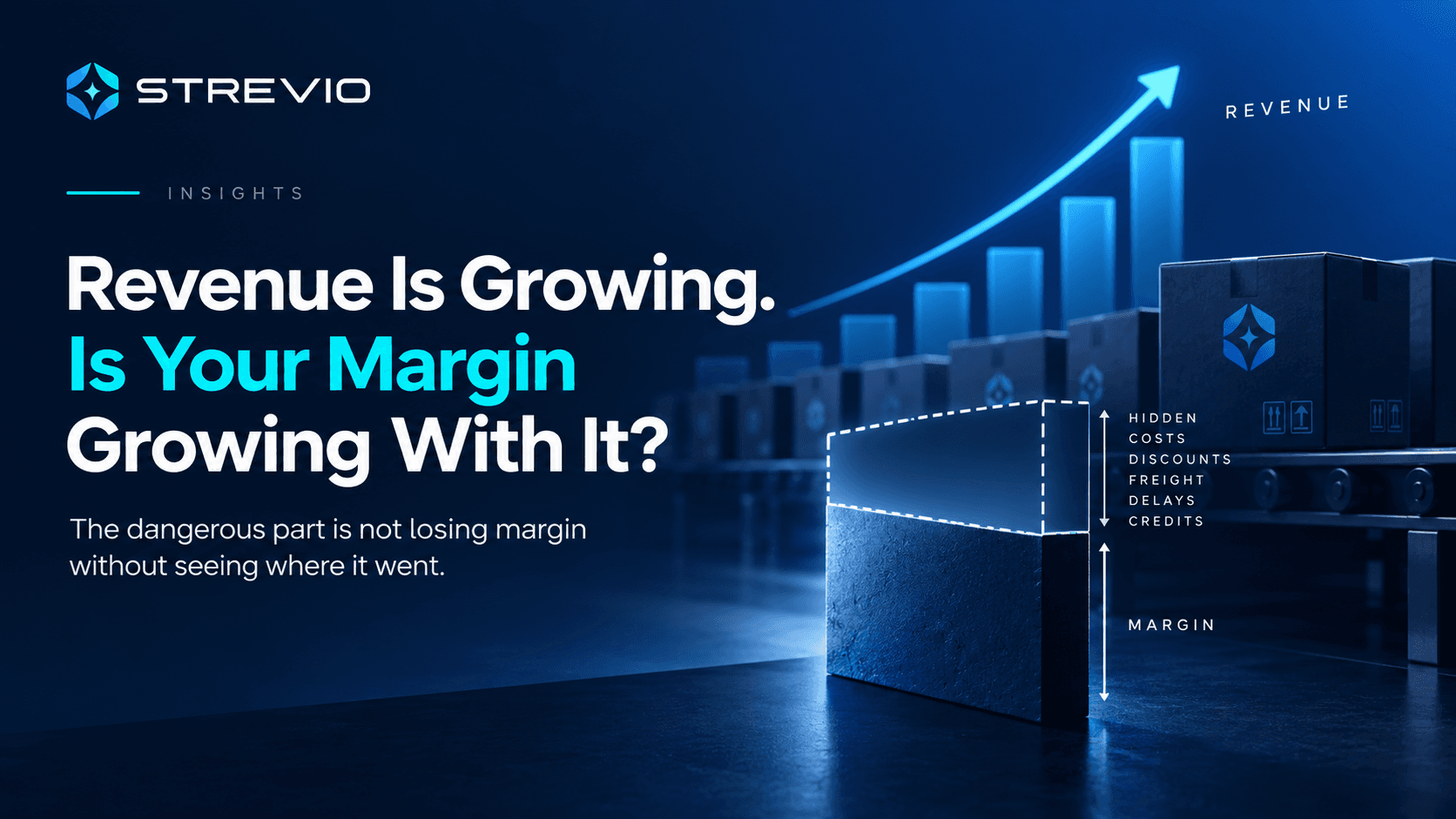
Revenue Is Growing. Is Your Margin Growing With It?
The dangerous part is not losing margin. It is losing margin without seeing where it went.
In This Article
- Revenue can make a business look healthier than it really is
- Small margin changes can create very large profit changes
- Your supplier price is not your real product cost
- There are really two margins on every order
- The margin you calculated is only as good as the costs you knew
- Emergency freight can destroy a good order
- Logistics is not a small cost line
- Knowing the freight bill is not enough
- A margin calculation can be mathematically perfect and commercially wrong
- Discounts are only the beginning of revenue leakage
- The biggest customer may not be the best customer
- The cost of serving a customer is often hidden across departments
- More revenue can actually make the business worse
- Month-end is too late to discover which order lost money
- You need to know where the margin is going
- Look at margin by order, product and customer
- Expected margin versus actual margin is one of the most useful comparisons
- A real STREVIO pattern: the information exists, but the business rebuilds it
- Eight signs margin leakage may be hiding in your business
- What should better margin visibility look like?
- What should be automated?
- What should stay human?
- Five questions every owner should ask about margin
- Do not turn margin management into another manual spreadsheet
- Better margin visibility changes behavior
- More orders are not the goal
- The most dangerous order may be the one everybody celebrates
- The question to ask tomorrow morning
- Revenue is growing. Make sure profit is coming with it.
Sales are up 25%. The team is busier than ever. More orders are going out. Revenue looks good. The company feels like it is growing. So why does the business not feel much more profitable?
Then finance takes a closer look at one of the large orders everyone celebrated a few weeks earlier. The supplier price increased slightly after the quotation was prepared. Freight cost more than expected. The customer negotiated an additional discount. Part of the shipment had to go by air because the supplier was late. A credit note was issued after delivery.
The order that looked very profitable when sales accepted it barely made money. Nothing dramatic happened. There was no catastrophic mistake. Margin simply disappeared one small piece at a time. And that is precisely what makes margin leakage dangerous.
Revenue grew. Profit did not.
For a trading, wholesale or distribution business, revenue can give an owner a reassuring picture. More orders. More customers. More volume. But revenue only tells you what the company sold. It does not tell you what the company actually kept. That is why one of the most important questions a growing business can ask is:
Revenue is growing. Is your margin growing with it?
Revenue can make a business look healthier than it really is
Revenue is easy to see. A HK$500,000 order feels more important than a HK$100,000 order. A customer buying HK$5 million per year looks more valuable than one buying HK$1 million. A sales team increasing turnover by 30% appears to be performing well. But none of those numbers answers the most important question: how much money did we actually make?
Our own buying-moment research repeatedly identifies this problem in trading and distribution businesses. One of the strongest phrases we captured was:
I thought we made money until we checked the real numbers.
The underlying problem is that purchase cost, freight, supplier charges, stock information and accounting records do not always align automatically. The result is hidden margin leakage, pricing mistakes and management decisions based on incomplete profitability information.
That buying moment is commercially important because it creates distrust. The owner stops believing the first margin number. Finance has another number. Sales has another. The ERP reports something else. Then somebody rebuilds a spreadsheet at month-end to understand what really happened. At that point the business may finally have the truth. But the opportunity to change the order disappeared weeks ago.
Small margin changes can create very large profit changes
This matters particularly in distribution because the underlying margins are often not huge. McKinsey analyzed 92 publicly traded distributors and found average EBITDA margins fell from 8.7% in 2022 to around 8.0% by 2026.
That decline may look small. It is only 0.7 percentage points. But McKinsey describes it as the equivalent of almost a tenth of industry profits disappearing.
~12%
improvement in profit margin for distributors that a one-percentage-point increase in gross margin can translate into, because much of that incremental margin flows through an already-established cost structure
McKinsey & Company, analysis of 92 publicly traded distributors
That is why one percentage point should never be dismissed as "it's only 1%." In a HK$50 million business, one percentage point of sales is HK$500,000. And depending on the company's underlying profitability, protecting one point of gross margin can create a disproportionately large improvement in what ultimately remains.
>22%
increase in EBITDA margin that a 1% price increase could produce, based on 140 publicly traded distributors
McKinsey & Company, July 2026 distributor pricing research
Not every SME has the economics of a publicly traded distributor. But the principle is universal: when margins are thin, small commercial mistakes can have very large profit consequences.
Your supplier price is not your real product cost
Imagine you buy a product for HK$60 and sell it for HK$100. It looks straightforward. HK$40 difference. Great margin.
Except HK$60 may only be the supplier price. How did the product get to your customer? There may also be:
- International freight
- Domestic transportation
- Insurance
- Customs duties
- Tariffs
- Import taxes
- Inspection charges
- Handling
- Warehousing
- Documentation
- Currency costs
- Special delivery charges
Your true cost may be HK$66. Or HK$72. Or HK$79. And suddenly the order looks very different. This is why landed cost exists. Odoo 19, for example, defines landed costs as additional costs associated with a product's arrival, including shipment, insurance, customs duties, taxes and other fees.
Your supplier's invoice tells you what you paid the supplier. It does not necessarily tell you what the product cost you.
For domestic businesses with simple logistics, the difference may be limited. For an international trading company moving physical goods between China, Europe, Hong Kong, Southeast Asia or the United States, it can be significant.
There are really two margins on every order
The first is the margin you believe exists when you accept the order. Suppose the customer price is HK$100. Your expected product cost is HK$60. Expected freight and other costs are HK$8. Expected margin: HK$32.
Then the order actually happens. The supplier charges HK$62. Freight rises from HK$8 to HK$10. A delivery problem requires HK$3 of additional logistics. The customer receives a HK$2 commercial credit. Actual margin: HK$23.
The order never stopped looking like a HK$100 sale. Revenue did not change much. But profit fell from HK$32 to HK$23. Nearly 30% of the expected margin disappeared.
That is the difference between margin when the decision was made and margin after reality happened. Both matter. If you only know the first, you risk celebrating orders that later disappoint. If you only know the second, you discover mistakes when it is too late to fix them. The objective should be to understand how the margin changes while the order is still alive.
The margin you calculated is only as good as the costs you knew
This is particularly important when costs are moving quickly. Supplier prices change. Freight changes. FX changes. Tariffs change. Customers negotiate. Shipment methods change. A customer originally accepts sea freight. Then they need the goods urgently. The order is moved to air. The sales value remains the same. The cost structure does not.
65% / 60%
of executives were renegotiating supplier pricing or planned to (65%), while 60% were passing tariff-related costs to customers or planned to
PwC, May 2025 survey
PwC also found 57% of executives believed they were missing opportunities because they could not make decisions quickly enough. Deloitte found a similar planning problem around tariff exposure: more than 70% of respondents in one 2025 Dbrief had not yet started their initial modeling and assessment of tariff impacts, despite the potential for higher input and logistics costs.
The point is not US trade policy. The point is volatility.
When costs move faster than your pricing process, margin can disappear between the quotation and the final delivery.
Emergency freight can destroy a good order
This is one of the most practical examples. An order is sold using normal sea freight assumptions. The product margin is healthy. Then the supplier is late. The customer's required delivery date does not move. Somebody has to make a decision: wait and disappoint the customer, or air-freight the goods?
The company chooses air freight. Commercially, that may be the correct decision. Perhaps the customer relationship is important. Perhaps penalties would be worse. Perhaps there is another contract at risk. The problem is not necessarily making the decision. The problem is when nobody sees what that decision did to the order margin.
Suddenly, the business can move from "this is a good order" to "we barely made money" — without anybody noticing until month-end.
And there is a second problem. If the business regularly solves supplier problems using expensive freight but does not connect those logistics costs back to the orders or suppliers that caused them, the same issue can repeat indefinitely. The supplier looks inexpensive. The customer looks profitable. The freight account looks high. But nobody connects the three.
Logistics is not a small cost line
For many businesses, transportation and warehousing represent material economics.
2.7% / 0.83%
median logistics and warehousing cost as a share of revenue across 4,081 organizations (2.7%), and median transportation cost across 1,456 organizations (0.83%)
APQC benchmarking
These are broad cross-industry figures. They are not targets for your business. A Hong Kong trading company importing bulky physical products may look completely different from a company selling high-value components. But the data reinforces something important: logistics is large enough that poor visibility or allocation can materially distort profitability. If your gross margin is 15%, a few percentage points of freight matter. If it is 8%, they matter even more.
Knowing the freight bill is not enough
Suppose you import one container containing two very different products. Product A: 1,000 small, expensive components. Product B: 20 huge, inexpensive pieces of equipment. Total freight: HK$40,000.
How should that HK$40,000 be allocated? Divide it equally by product line? By unit quantity? By value? By weight? By volume? Those methods can create very different answers.
Odoo's landed-cost functionality illustrates this well because it supports several allocation approaches: equal allocation, by quantity, by current cost, by weight and by volume.
Why does that matter? Because an incorrectly allocated cost can make one product look more profitable and another less profitable. Management can then make the wrong decisions — raise the wrong price, stop selling the wrong product, negotiate aggressively with the wrong supplier, push the wrong product category. The business technically recorded the freight expense correctly. But the commercial interpretation was wrong.
Knowing the cost is not enough. You also need to know what caused the cost.
A margin calculation can be mathematically perfect and commercially wrong
This is especially relevant to ERP users. Odoo 19 can calculate margins directly on quotations and sales orders. Its standard formula is straightforward: Sales Price − Cost, and the system can display both the absolute margin and margin percentage.
There is nothing wrong with the calculation. The interesting question is: what is inside "Cost"?
If the product cost accurately represents the economics, excellent. But imagine the cost currently reflects last month's supplier price, while today's supplier price changed. Or it excludes freight. Or it includes average freight that does not reflect a special shipment. Or FX moved. Or customs changed. Or an unexpected supplier charge appeared. Or a customer-specific cost is accounted for elsewhere.
The formula remains mathematically correct. Sales Price minus Cost still equals Margin. But if Cost does not reflect what the business will genuinely spend, the margin number can give management false confidence.
A margin calculation can be mathematically perfect and commercially wrong. That is not an ERP problem. It is an operational information problem.
Discounts are only the beginning of revenue leakage
Cost is one side of margin. The other side is what you actually keep from the selling price. Suppose your official selling price is HK$100. But then a customer receives a 5% discount, a year-end rebate, free freight, longer payment terms, a promotional credit, a service allowance, or another commercial concession. The invoice may still look respectable. The true value retained by the company can be much lower.
McKinsey has documented this issue through analysis of what it calls realized or "pocket" price: what remains after discounts, incentives and other commercial concessions.
16.3 pts
revenue reductions that did not appear directly on invoices, found in one global lighting-company example — not a benchmark for every SME, but illustrative of the pattern
McKinsey & Company
The price on your invoice is not always the money you actually keep.
The biggest customer may not be the best customer
Customer A generates HK$5 million revenue per year. Customer B generates HK$2 million. Who is more valuable? At first glance, Customer A.
But Customer A demands large discounts, places small urgent orders, changes requirements constantly, requires special packing, expects air freight when deliveries slip, returns goods frequently, pays slowly, and consumes large amounts of operations and customer-service time.
Customer B orders predictably, accepts standard logistics, pays on time, rarely changes orders, and creates almost no operational noise.
Which customer is more profitable? Revenue alone cannot answer that. This is where owner intuition can become dangerous. People naturally focus on large sales numbers. A HK$5 million account feels strategically important. And perhaps it is. But the right question is not "how much do they buy?" It is:
How much do we keep after serving them?
The cost of serving a customer is often hidden across departments
Some customer costs are easy to see: discount, freight, credit note. Others are scattered through the organization.
A customer sends five order revisions. Operations changes the order five times. Procurement adjusts quantities. The warehouse repacks goods. Finance issues another document. Customer service exchanges 20 emails. Management intervenes because the deadline becomes critical.
None of those activities necessarily appears as a line on the sales order. But the business paid people to do them. One difficult customer may therefore consume several times more operational capacity than another customer with similar revenue.
This does not mean every company needs to calculate the exact cost of every email. That would be ridiculous. The objective is to identify material patterns. Which customers regularly create special freight, returns, credits, rush orders, manual reconciliation, repeated order changes, payment delays, or disproportionate operational coordination? Those patterns help explain why revenue and profit sometimes move in different directions.
More revenue can actually make the business worse
This sounds provocative. But imagine a business with weak margin visibility. It wins more customers. Revenue rises 30%. Great.
But the additional volume also produces more discounts, more supplier chasing, more emergency freight, more stock buffers, more manual reporting, more order exceptions, and another operations employee.
Revenue increased. Payroll increased. Working capital increased. Operational complexity increased. The company is busier. The owner is busier. Everyone feels successful because the top line grew. But if profit barely moved, the company did not scale very well. It simply became larger.
There is a big difference between growth and profitable growth.
Month-end is too late to discover which order lost money
Many SMEs only get their most reliable profitability information after finance closes the month. Supplier invoices have arrived. Freight has been reconciled. Credits are entered. Stock valuation is updated. Someone produces the management accounts. Finally, the owner can see what happened.
That information is important. Accounting needs to be accurate. But commercially, it may arrive too late. The order shipped three weeks ago. The customer price cannot be renegotiated. The freight choice has already been made. The supplier has already been paid. The same quotation logic may already have been used on ten new orders.
A report telling you last month which orders lost money is useful accounting. It is not operational control.
Operational control means seeing material margin changes while somebody can still make a decision. Can we change the shipment method? Can we negotiate with the supplier? Should we pass part of the increase to the customer? Should we reject an additional discount? Should we stop accepting this product at this price? Should another supplier be used next time? Should the customer receive a different commercial arrangement? Those decisions require margin information before the story is finished.
You need to know where the margin is going
Imagine gross margin falls from 22% to 18%. The number tells you there is a problem. It does not tell you why.
- Supplier prices?
- Freight?
- FX?
- Discounts?
- Tariffs?
- Product mix?
- Customer mix?
- Returns?
- Emergency deliveries?
- Slow-moving stock?
- A specific supplier?
- A particular salesperson?
- One customer?
- One product family?
Until the business can answer that, management cannot act intelligently. Cutting costs across the company because margin fell may be completely wrong if 80% of the leakage comes from one product group or one customer behavior.
A useful margin system should help answer where the difference came from — not simply what the final percentage is.
Look at margin by order, product and customer
The total company margin is useful. But underneath that number are thousands of different transactions. Some highly profitable. Some acceptable. Some nearly worthless. That is why three perspectives matter.
Margin by order
Did this particular transaction actually perform as expected? This is where you detect unexpected freight, supplier changes, special discounts, credits, and operational exceptions.
Margin by product
Are certain SKUs consistently less profitable than management thinks? Perhaps freight allocation is wrong. Perhaps one supplier is expensive. Perhaps the product creates more returns. Perhaps the market price no longer supports the cost.
Margin by customer
Does a high-revenue customer actually generate attractive economics? Or do discounts, delivery demands and operational complexity consume much of the contribution? Those three views provide completely different management information.
Expected margin versus actual margin is one of the most useful comparisons
Suppose a sales order was accepted at an expected margin of 28%. After delivery, the actual margin is 21%. The seven-point difference deserves investigation. Not because 21% is necessarily bad — perhaps it is still an excellent order. The important question is: why was our expectation wrong?
Was supplier pricing outdated? Was freight underestimated? Was the customer's discount changed? Was there a currency movement? Did the shipment method change? Did the customer require a credit?
Once the business tracks that difference repeatedly, patterns emerge. Perhaps one salesperson consistently overestimates margin. Perhaps one supplier generates unexpected charges. Perhaps one product family has unreliable freight assumptions. Perhaps one customer repeatedly requires expensive exceptions. That is actionable management information.
A real STREVIO pattern: the information exists, but the business rebuilds it
International trading company: reconciliation happening outside the ERP
Our current published STREVIO success stories do not contain a clean claim such as "margin increased by 12%." We should not invent one. But one international trading case shows the underlying problem clearly.
The business was already using Odoo. Yet Odoo information still had to be exported and rebuilt in Excel. Remaining quantities were recalculated manually. Backorders were tracked separately. Dropshipping stock was maintained outside the main ERP workflow. Supplier invoices were manually reconciled with stock references. Operational dashboards had to be rebuilt by hand.
Those are exactly the kinds of fragmented information flows that make real profitability harder to understand. STREVIO connected the relevant Odoo data, Excel logic, supplier-held inventory information and supplier invoices into a more structured workflow. Stock and invoice reconciliation, remaining-quantity calculations and exception detection became automated, while management gained clearer visibility over customer commitments, stock, supplier invoices and operational exceptions.
Measured Results
- Stock and invoice reconciliation became automated
- Remaining-quantity calculations and exception detection automated
- Clearer management visibility over customer commitments, stock, supplier invoices and operational exceptions
The important lesson is not "install a margin dashboard." It is: your margin can only be as reliable as the operational information feeding it.
Read the full International Trading storyEight signs margin leakage may be hiding in your business
You do not need a complex finance project to spot the warning signs.
1. Finance regularly changes the margin after the order has shipped
Some adjustment is normal. Large recurring differences between expected and actual margin deserve investigation.
2. Sales uses supplier price as product cost
If freight, duties or other material costs are significant, the margin may be overstated from the beginning.
3. Emergency freight is treated as "just logistics"
If air shipments or expedited deliveries are caused by specific customer orders or supplier failures, separating the cost completely from those transactions hides the commercial consequence.
4. Nobody knows which customers create the most credits or exceptions
High revenue can conceal poor economics.
5. Landed costs are applied late or inconsistently
The business may see a margin when quoting and a very different margin when finance finishes reconciling.
6. Margin analysis only happens monthly
Management can understand what happened but cannot influence the transaction anymore.
7. Large customer accounts are judged primarily by revenue
Revenue is useful. Profitability is better.
8. When margins fall, nobody can explain exactly where the money went
This is the strongest signal of all. A margin percentage without an explanation is only a symptom.
What should better margin visibility look like?
Not another complicated finance dashboard. Management should be able to answer practical questions.
- Which orders are currently below expected margin?
- Which product costs changed materially?
- Which customers receive the most commercial concessions?
- Which orders incurred exceptional freight?
- Which supplier changes affected profitability?
- Which products consistently produce lower actual margin than quoted margin?
- Which customers look large by revenue but weak by contribution?
- Where is margin deteriorating this month?
- Which orders require intervention before they ship?
That is useful visibility.
What should be automated?
The repetitive collection and reconciliation. Depending on the company, that could mean automatically bringing together sales order information, purchase costs, supplier invoices, freight, landed costs, customer discounts, credit notes, inventory movements, and relevant logistics costs.
The system can then flag large cost changes, orders falling below target margin, unexpected supplier charges, unusual freight, repeated customer concessions, and differences between expected and actual profitability.
The point is not to ask AI to decide whether a customer is worth keeping. The point is to stop a person from spending half a day assembling the information required to make that decision.
What should stay human?
- Pricing strategy
- Customer negotiation
- Supplier negotiation
- Deciding whether to absorb a cost increase
- Choosing to protect an important customer relationship
- Deciding whether to air-freight an urgent shipment
- Setting target margins
- Changing commercial terms
- Determining whether a strategically important customer justifies lower profitability
Those are business decisions. A system should make the economics visible. People should decide what to do about them.
Automate the calculation and the warning. Keep the commercial decision human.
Five questions every owner should ask about margin
1. When we quote a customer, what exactly is included in our cost?
Supplier price only? Or the real expected landed cost?
2. How different is our actual margin from the margin we expected when the order was accepted?
If nobody knows, start measuring it.
3. Which costs most often appear after the selling price has already been agreed?
Freight? Supplier increases? FX? Discounts? Credits?
4. Which customers create the most revenue — and which create the most profit?
Those may not be the same list.
5. How quickly can management see when an order's profitability changes?
If the answer is "at month-end," there may be an operational visibility problem.
Do not turn margin management into another manual spreadsheet
Once owners become concerned about profitability, a predictable thing happens. Someone creates Excel. Sales exports revenue. Finance exports costs. Operations adds freight. Someone adds supplier information. Then a formula calculates "real margin."
Excellent. Except somebody needs to maintain it. Every week. Every month. Every time supplier information changes. Soon, margin visibility itself becomes another manual operational process.
The spreadsheet is not necessarily wrong. It can be an excellent prototype for understanding what management needs. But if the business depends permanently on people exporting, copying and reconciling information before anybody can see profitability, the process will struggle as order volume grows. This is exactly the pattern STREVIO sees repeatedly across operational workflows: the answer exists, the data exists, but someone needs to rebuild the answer.
Better margin visibility changes behavior
This is ultimately why the information matters.
If sales sees that a discount moves the order below target margin before approving it, behavior changes. If procurement can see that one supplier's low purchase price is repeatedly offset by expensive emergency freight, supplier evaluation changes. If management sees that one large customer creates weak contribution after service costs, commercial discussions change. If the owner sees that one product category creates revenue but almost no profit, the assortment changes. If logistics costs consistently destroy certain orders, delivery terms change.
Visibility should lead to decisions. Otherwise it is merely reporting.
More orders are not the goal
This connects margin directly back to Operational Capacity. Imagine the same team handles 30% more orders. That sounds excellent. But if those additional orders have worse economics, the company may simply be using more capacity to make less money per transaction.
Operational Capacity should therefore not mean do more work at any cost. It means creating the ability to handle more valuable work without allowing people, cost and complexity to increase at the same rate.
That is why margin belongs inside the Operational Capacity conversation. The company should not merely ask "can we handle more orders?" It should also ask:
Should we want more of these orders?
The most dangerous order may be the one everybody celebrates
A very large order lands. Sales is excited. Revenue jumps. Management congratulates the team. Procurement places the supplier order. Operations works hard to deliver.
Then three months later, finance discovers the supplier price moved, freight was higher, the customer had received several concessions, and the urgent part of the shipment consumed most of the remaining profit.
The order was not a disaster. It simply was not nearly as valuable as everybody thought. This is why margin visibility is not a finance luxury. It changes how the company decides what business it wants.
The question to ask tomorrow morning
Pick one large order that shipped recently. Not necessarily a bad one. A normal one. Ask: what margin did we expect when we accepted this order? Then ask: what margin did we actually make?
If the answers are different, follow the gap. Where did the money go? Supplier cost? Freight? FX? Discount? Credit? Handling? Something else?
Then choose ten orders. Then twenty. You may discover that your margin problem is concentrated in one specific area. Or you may discover something more important: nobody can answer the question without rebuilding the numbers manually.
That itself is a buying moment. Because the dangerous part is not losing margin. The dangerous part is losing margin without seeing where it went.
Revenue is growing. Make sure profit is coming with it.
A business can grow revenue by taking more orders. It can grow volume by accepting more customers. It can make everyone busier. None of those things guarantees the company is becoming stronger.
A stronger business understands the economics behind the activity. It knows which products generate value. Which customers generate value. Which suppliers protect or destroy value. Where exceptional costs appear. And when an order is moving away from the economics that justified accepting it.
That does not require the owner to become an accountant. It requires the business to make the right operational information visible at the right time.
Revenue tells you how much business you did. Margin tells you how much of that business was worth doing.
Not Sure Where Your Business Is Losing Capacity?
That's Exactly What This Is For
When you work inside a business every day, inefficient workarounds stop looking like workarounds — they simply become “the way we do things.” That's exactly why we built the STREVIO Free Operational Capacity Assessment: a self-service, 3-minute check with no consultation and no technical knowledge required, giving you a first view of where your business may be losing time, profitability and visibility, and where to look first.
Take the Free Operational Capacity AssessmentFrequently Asked Questions
What is margin leakage?
Margin leakage occurs when the profit a business expects from a sale is reduced by costs or commercial concessions that are not fully visible when the transaction is accepted. Examples can include supplier price increases, freight, duties, discounts, rebates, credit notes, special handling or emergency logistics. The issue is not simply that costs exist — it is that management may not see their impact on the order quickly enough.
What is landed cost?
Landed cost is the cost of getting a product to the point where the business can use or sell it, rather than simply the price paid to the supplier. Odoo 19 includes shipment, insurance, customs duties, taxes and other fees among the additional costs that can be included in landed cost.
What is the difference between gross margin and markup?
Gross margin expresses profit as a percentage of selling price (e.g. selling price HK$100, cost HK$60, profit HK$40, gross margin = 40%). Markup expresses the profit relative to cost (40 / 60 ≈ 66.7%). Confusing the two can create major pricing errors.
Can Odoo calculate margin on sales orders?
Yes. Odoo 19 can show margin on quotations and sales orders and calculates it from sales price minus product cost, displaying both the absolute margin and margin percentage. The practical question is whether the cost used by the calculation reflects the economic reality relevant to the business.
Can Odoo include freight and duties in product cost?
Odoo's landed-cost functionality can account for costs such as freight, insurance, customs duties and taxes and allocate them across received products. The appropriate allocation method depends on the business and the nature of the cost.
How should freight be allocated across products?
There is no single method suitable for every shipment. Odoo supports several methods, including equal allocation, by quantity, current cost, weight and volume. The important business principle is that the allocation should reasonably reflect what caused the cost — otherwise product-level profitability can become distorted.
Why is my actual margin lower than my quoted margin?
Common reasons include higher supplier costs, unexpected freight, currency changes, duties, discounts, credits, returns, special handling, and emergency delivery costs. Comparing expected margin with actual margin helps identify which causes occur most often.
Should I calculate profitability by customer?
For many trading and distribution businesses, yes. Customers can generate different levels of discounting, freight, returns, special handling and operational coordination. A high-revenue customer can therefore be less profitable than a smaller, easier-to-serve customer.
How often should we monitor margin?
The appropriate frequency depends on the business. The principle is to see important deviations while there is still time to act. If meaningful margin problems are only discovered after month-end, management may have accurate historical reporting but limited operational control.
How can automation help with margin visibility?
Automation can bring together information that is currently spread across sales orders, purchase costs, supplier invoices, logistics, inventory and finance. It can also identify exceptions, such as orders whose expected margin has materially deteriorated. Commercial and pricing decisions should remain human-owned.
Does more revenue always mean more profit?
No. If revenue growth is accompanied by lower margins, higher payroll, more expensive logistics, more discounts or higher operating complexity, profit may grow much more slowly than revenue or not grow at all. McKinsey's 2026 distribution research highlights how even small gross-margin changes can create disproportionately large effects on profitability.
About The Author
Alexandre Besson
Co-Founder & Chief Business Strategist, STREVIO
After more than 20 years running operations across Europe and Asia, Alexandre focuses on helping SMEs remove the manual coordination, information gaps and repetitive work that make businesses harder to run as they grow. STREVIO helps businesses recover Operational Capacity by connecting the systems and information they already use, improving operational visibility and orchestrating workflows so existing teams can handle more business without adding people, cost and complexity at the same rate.