Insights
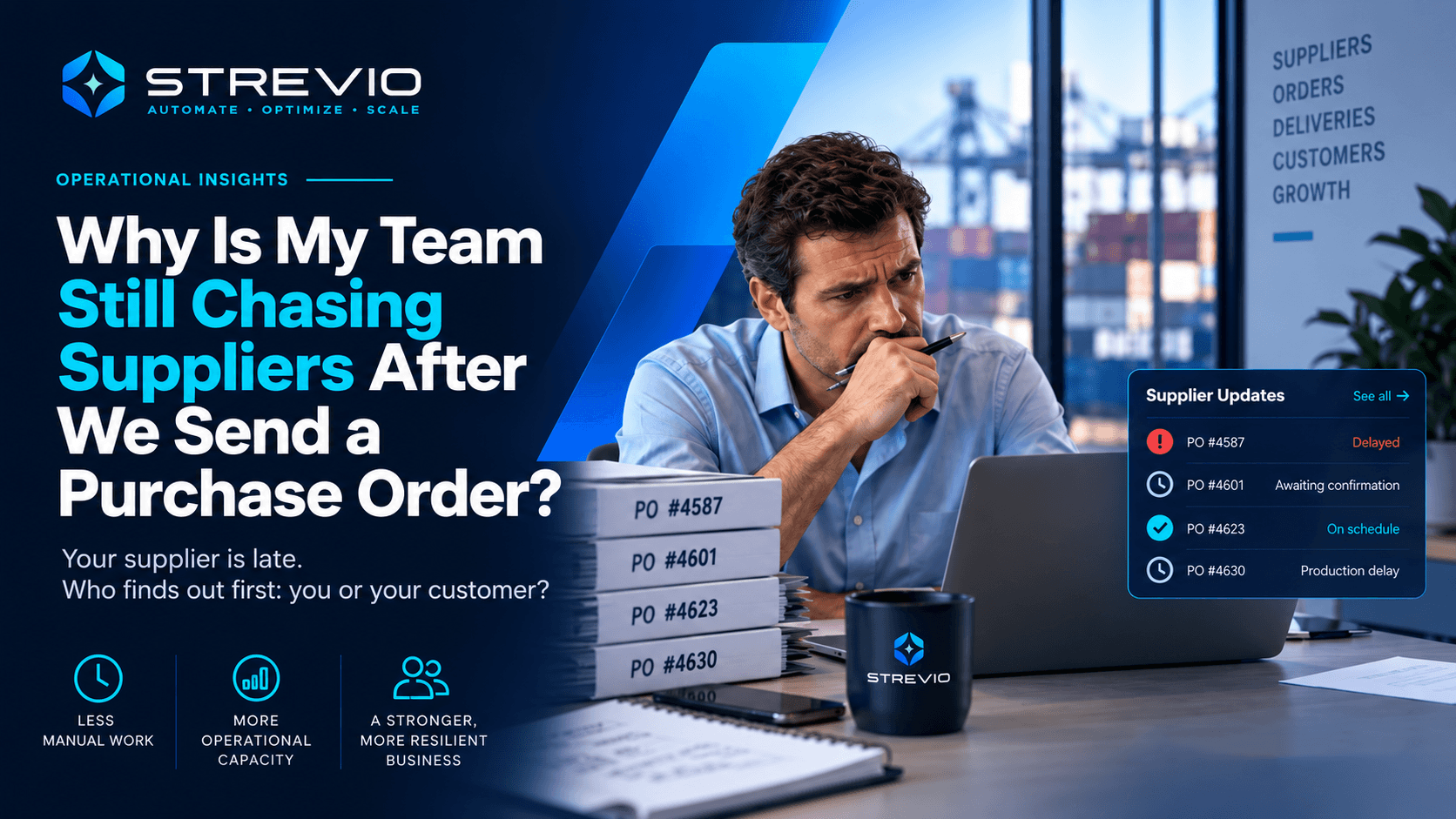
Why Is My Team Still Chasing Suppliers After We Send a Purchase Order?
Your supplier is late. Who finds out first: you or your customer?
In This Article
- The Purchase Order Is Not the End of the Process
- Why Do Teams Keep Chasing Suppliers?
- Supplier Chasing Doesn't Look Expensive One Email at a Time
- The Expensive Part Is Not the Follow-Up
- Your Supplier Is Late. Who Finds Out First: You or Your Customer?
- Why Your ERP Has Not Automatically Solved This
- The Problem Is Not Missing Data. It Is Missing Connection
- Purchase-Order Acknowledgement Matters More Than It Looks
- The Best Procurement Teams Should Manage Exceptions, Not Every PO
- Automating Supplier Follow-Up Does Not Mean Automating Supplier Relationships
- Procurement Leaders Are Already Prioritizing Visibility
- Chasing Suppliers Can Also Create Too Much Inventory
- A Real STREVIO Example: From Chasing Every PO to Managing Exceptions
- More Orders Should Not Mean More Chasing
- What Good Purchase-Order Visibility Should Actually Look Like
- Seven Signs Your Supplier Follow-Up Has Become an Operational Problem
- What Should Be Automated?
- What Should Stay Human?
- Another External Example: Viking Yachts
- Don't Buy Another Tool Before Understanding the Problem
- Five Questions Every Owner Should Ask Their Procurement Team
- What the Better Operating Model Looks Like
- The Real Goal Is Operational Capacity
- Before You Hire Another Buyer, Find Out How Much of the Work Should Disappear
You send the purchase order. Then somebody waits.
- Did you receive the PO?
- Can you confirm the delivery date?
- Any update?
- Is production on schedule?
- When will it ship?
- What about the remaining quantity?
- Can you confirm the new date?
Multiply that by 20 suppliers. Then 50. Then hundreds of open purchase orders. Suddenly, what looks like a few harmless emails has become somebody's job. Or several people's jobs. And every time the business grows, the workload grows with it.
More orders mean more purchase orders. More purchase orders mean more supplier confirmations. More confirmations mean more dates to check. More dates mean more potential changes. More changes mean more emails, spreadsheets, meetings, follow-ups and customer questions.
Eventually, your procurement team is not really managing suppliers anymore. They are managing information about suppliers. And too often, the system only works because somebody remembers to ask:
Any update?
That is not visibility. That is chasing. And it is one of the most common forms of hidden Operational Leakage we see in trading, wholesale, distribution and manufacturing businesses.
The good news is that much of this work should not require another person. The real objective is not to eliminate communication with suppliers. It is to stop your team from having to manually monitor every order just to discover which ones need attention.
The Purchase Order Is Not the End of the Process
For many businesses, creating the purchase order is the structured part. Someone raises the requirement. The order gets approved. The PO goes into Odoo, SAP Business One, NetSuite or another ERP. It is sent to the supplier. Done.
Except, operationally, almost nothing is done. The supplier still needs to receive the order. They may need to acknowledge it. They need to confirm the quantity. They need to confirm the price. They need to commit to a date.
Sometimes they accept the requested date. Sometimes they don't. Sometimes one product is available and another isn't. Sometimes production slips. Sometimes raw materials arrive late. Sometimes the factory tells your buyer that the shipment will be delayed by ten days. Sometimes that message arrives by email. Sometimes by WhatsApp. Sometimes during a phone call. Sometimes it does not arrive at all until somebody asks.
Then, after the goods are supposedly ready, you still have packing, shipping, documents, forwarders, partial quantities, customs and delivery to manage. So the most important part of purchase-order management often happens after the PO has already been created.
Creating the purchase order is not usually the problem. Everything that happens after you send it is.
Why Do Teams Keep Chasing Suppliers?
Usually not because the employees are badly organized. And often not because the company has no system. The problem is that the latest operational information is scattered across several places.
The ERP may contain the purchase order. An email contains the supplier's confirmation. Another email contains a revised delivery date. A spreadsheet tracks backorders. The logistics person knows that the forwarder has changed the sailing date. A buyer remembers that a factory promised to prioritize one item. Customer service has already promised something to the customer based on the previous information.
Every individual may have part of the truth. Nobody has the complete operational picture. That exact pattern appears repeatedly in STREVIO's buying-moment research. One recurring situation is:
I have to ask where every order is.
Another is:
We keep chasing suppliers and then explaining delays to customers.
And when shipment information is fragmented:
Nobody tells me until there is a problem.
Those aren't software complaints. They are symptoms of the same operational problem: the business cannot see a supplier commitment changing without a human being going looking for the information.
Supplier Chasing Doesn't Look Expensive One Email at a Time
One follow-up email takes two minutes. That does not sound like a problem. But procurement work does not happen one email at a time.
APQC benchmarks show the scale at which purchasing teams operate.
1,619 POs/year
median number of purchase orders processed per employee handling material and service ordering, across more than 5,000 participating organizations
APQC
10 days
median supplier lead time across 3,077 companies, measured from transmission of the PO to receipt of the purchased material
APQC
Now imagine that a meaningful percentage of those purchase orders requires several interactions. Acknowledgement. Confirmation. Changed delivery date. Second confirmation. Shipment update. Backorder follow-up. Document request. You are no longer talking about two minutes. You are talking about a recurring operational workload embedded inside every purchase order. And unlike processing the PO itself, much of that workload is difficult to see because it happens in inboxes, conversations and spreadsheets.
Supplier chasing doesn't look expensive one email at a time. It becomes expensive when you multiply it across every open purchase order, every day.
The Expensive Part Is Not the Follow-Up
The email itself is not the biggest problem. The bigger problem is when the information arrives too late. Your supplier moves the delivery date from the 15th to the 29th. What happens next?
- Which customer orders depend on that delivery?
- Do you have alternative stock?
- Can another supplier cover the shortage?
- Does customer service need to change a commitment?
- Does sales need to speak to a key account?
- Should another shipment be expedited?
- Does the delay affect production?
- Is there still time to do something sensible?
Those questions are where operational visibility becomes commercially important. If your business discovers the delay early, you have choices. If you discover it after the customer asks where the order is, you have explanations.
Our buying-moment database captures the distinction very clearly. Supplier delays create unreliable customer promises, management time, expedited freight costs and lost trust. Late shipments discovered too late turn customer service into reactive problem-solving. So the goal of better purchase-order tracking is not simply "send fewer supplier emails." It is:
Know about the problem while there is still time to act.
Your Supplier Is Late. Who Finds Out First: You or Your Customer?
This is perhaps the best test of the entire procurement process. A customer calls: "Where is my order?" What happens next? Can your customer-service person answer immediately? Or do they message procurement? Does procurement check the ERP? Then check email? Then ask the buyer? Then contact the supplier? Then wait? Then come back to the customer?
If so, the customer has effectively triggered an internal investigation. And the business may only have become aware of the problem because the customer asked the question. Our internal buying-moment research contains another painfully familiar sentence:
I need to ask three people before I can answer the customer.
That dependency creates more than inefficiency. It makes customer service slower. It interrupts procurement. It makes information dependent on individual knowledge. It increases the risk that two employees give different answers. And as the business grows, the number of interruptions grows too.
A company can hire another customer-service person. But if that new employee still needs to ask procurement for every answer, the business has increased payroll without fixing the underlying capacity problem.
Why Your ERP Has Not Automatically Solved This
This is where business owners sometimes become frustrated.
We already have an ERP. Why are my people still chasing everything?
It is a reasonable question. Modern ERP systems can already manage a great deal. Take Odoo as an example. Odoo 19 can manage vendor lead times, calculate expected-arrival dates, identify purchase orders whose expected dates have passed, and surface late POs in the purchasing dashboard.
That is useful. And companies should use those native capabilities properly. But there is a fundamental limitation that has nothing to do with whether Odoo is good or bad:
Your ERP can only act on the information it has.
Suppose Odoo currently says "Expected Arrival: 20 September." Then your supplier sends Susan an email: "Sorry, due to a production delay the goods will now be ready 4 October." What does Odoo know? Possibly nothing — unless Susan updates the information.
And what happens if Susan is busy? Or the message is buried in a long email chain? Or the supplier sends the update through WhatsApp? Or the supplier does not proactively communicate the delay and somebody has to ask? The ERP may still show 20 September. Technically, the ERP is not wrong based on the information stored inside it. Operationally, the business is working from an outdated commitment.
The transaction exists inside the ERP. The latest operational reality may still exist outside it.
The Problem Is Not Missing Data. It Is Missing Connection
Businesses often have far more information than they realize. The PO exists. The supplier confirmation exists. The changed delivery date exists. The shipment information exists. The backorder list exists. The customer order exists. The stock exists.
The problem is often that these pieces of information do not work together. That is why employees keep rebuilding the answer. Our buying-moment database describes this very directly:
The information exists somewhere, but I can't see it.
When ERP, Excel, email and individual knowledge remain fragmented, companies get slow decisions, missed exceptions and dependence on key employees. This is also why adding another dashboard does not automatically solve the problem. A dashboard showing yesterday's information more beautifully is still yesterday's information. Operational visibility depends on capturing the relevant changes and connecting them to the business consequences.
Purchase-Order Acknowledgement Matters More Than It Looks
A surprisingly important moment is simply: has the supplier actually confirmed the order? Many SMEs assume that sending a PO means the supplier has accepted it. That is not necessarily true.
The supplier may not have opened it. They may disagree with the requested date. They may only be able to deliver part of the quantity. The price may have changed. The product may no longer be available. Nothing is really committed until the supplier has responded.
A vendor-published SourceDay case study involving JBT AeroTech provides an extreme but useful example. Before changing its supplier communication process, JBT reported that parts were missing at production start 31% of the time, suppliers delivered on time only 68% of the time, and JBT delivered to customers on time 69% of the time.
100%
of the time a new PO had not been acknowledged by a supplier, it arrived late in the period JBT AeroTech analyzed
SourceDay / JBT AeroTech case study
That does not mean every company will see the same relationship. But it illustrates why acknowledgement is not administrative trivia. It is the first evidence that the supplier has actually seen and accepted your requirement.
The Best Procurement Teams Should Manage Exceptions, Not Every PO
Imagine you have 300 open purchase orders. Do your buyers really need to think about all 300 today? Probably not. Perhaps 220 are confirmed and progressing normally. 45 require a routine confirmation. 20 have changed dates. 10 may affect customer commitments. 5 require immediate management intervention.
Those five are the ones that deserve human attention. But if the business cannot automatically distinguish the five from the other 295, somebody has to check everything. That is the fundamental difference between manual monitoring and management by exception.
Manual monitoring says: "Check every order to see whether something is wrong." Exception management says: "Tell me which orders require a decision."
That distinction matters enormously as volume grows. At 30 orders, manual checking may feel manageable. At 300, it becomes somebody's job. At 3,000, it becomes a department.
This is exactly what we mean by Operational Capacity. The objective is not to remove people from procurement. It is to make sure that increasing order volume does not require increasing the number of people whose main job is checking whether anything changed.
Automating Supplier Follow-Up Does Not Mean Automating Supplier Relationships
This distinction is important. Good supplier management is human. Negotiating better terms is human. Handling a serious quality issue is human. Deciding whether to trust a supplier with a strategic product is human. Discussing future capacity is human. Resolving a complicated commercial disagreement is human. Building a long-term relationship is human.
Sending "Can you confirm the PO?" and then three days later "Any update?" does not require much strategic human talent. Neither does checking 200 orders every morning just to identify the five that changed.
McKinsey has found that companies with strong supplier-collaboration capabilities tend to outperform peers, and in a survey of more than 100 organizations, companies that regularly collaborated with suppliers showed higher growth, lower operating costs and greater profitability.
That is another reason to free buyers from repetitive chasing. Their valuable time should go toward working with suppliers, not merely asking suppliers for information. There is an important difference between supplier communication and supplier relationship management. One keeps the information moving. The other creates business value.
Procurement Leaders Are Already Prioritizing Visibility
This isn't a niche problem. Deloitte's 2025 Global Chief Procurement Officer Survey collected responses from more than 250 procurement leaders across 40 countries.
64% / 61%
of procurement leaders prioritized greater supply-chain visibility (64%) and better supplier information sharing and collaboration (61%) as effective strategies for managing supply risk
Deloitte 2025 Global Chief Procurement Officer Survey
84% vs 59%
of the time stronger digital performers met or exceeded supplier-performance objectives, versus followers
Deloitte 2025 Global Chief Procurement Officer Survey
Better information does not just make procurement easier. It helps the business manage suppliers better.
Chasing Suppliers Can Also Create Too Much Inventory
There is another consequence business owners sometimes miss. When supplier delivery becomes unpredictable, companies protect themselves. They order earlier. They buy extra stock. They increase buffers. That seems rational — a missing component can stop an order, production line or customer delivery, so carrying additional stock may feel safer than trusting an unreliable supply process.
But safety stock costs money. It consumes cash. It takes warehouse space. And it can eventually become obsolete.
$800,000
of inventory JBT AeroTech reported eliminating from one supplier alone while improving that supplier's on-time delivery from 68% to 89%, per a vendor-published case study — not a universal benchmark, but illustrative of the mechanism
SourceDay / JBT AeroTech case study
The mechanism is logical: the less confident you are about supplier commitments, the more inventory you may feel you need to protect yourself. Visibility can therefore affect not only employee time but working capital.
A Real STREVIO Example: From Chasing Every PO to Managing Exceptions
Hong Kong wholesale and distribution business
One Hong Kong wholesale and distribution business we worked with had exactly this problem. The company was already running an ERP. It had international suppliers. It had growing order volumes. The technology existed. The information existed.
But purchase orders, supplier confirmations, promised dates, shipment information and customer commitments were distributed across the ERP, spreadsheets and email conversations. Someone had to chase every purchase order to understand what was happening. When a supplier became late, the customer impact wasn't immediately visible. Backorders were checked repeatedly. Staff kept checking ERP, Excel and email for the same answers. Managers were spending time chasing updates instead of managing exceptions.
The answer was not to replace the ERP. It was to connect the operational information surrounding the ERP. Purchase-order status, supplier commitments, backorders and delivery exceptions became visible together. Instead of checking every PO, procurement could focus on suppliers and orders requiring intervention. Customer-facing staff could access more reliable order and delivery information.
Measured Results
- 60% less manual procurement tracking and supplier follow-up
- More than 3 hours of operational capacity recovered every day
- 35% more orders handled by the same operational team without increasing headcount
- Live visibility across supplier delays, backorders and customer order status
The objective was not simply to save a few emails. The business increased the amount of work the existing team could handle.
Read the full Wholesale & Distribution storyMore Orders Should Not Mean More Chasing
This is where supplier follow-up becomes a growth issue. Suppose your company increases sales by 30%. Great. But if that creates 30% more POs, 30% more confirmations, 30% more supplier follow-ups, 30% more backorders, 30% more shipment updates, and 30% more customer questions, then operations may need 30% more people just to keep the same level of service. That is growth. But it is not really scale.
Our buying-moment database captures the problem as:
Every time we grow, we need another person.
As coordination workload rises proportionally with customers and orders, payroll and complexity rise with revenue. The objective should be different:
Grow order volume faster than coordination workload.
That is what operational leverage looks like in a practical SME.
What Good Purchase-Order Visibility Should Actually Look Like
Good visibility does not mean displaying 400 POs on a dashboard. That may simply give you 400 things to stare at. The business should be able to answer practical questions immediately.
- Which suppliers have not acknowledged new POs?
- Which delivery dates have changed?
- Which orders are already late?
- Which suppliers repeatedly change commitments?
- Which backorders are still unresolved?
- Which customer orders depend on the delayed supply?
- Which shipments are approaching a critical date?
- Which discrepancies require human intervention today?
- Which orders are progressing normally and therefore require no attention at all?
That final question is important. A good operational system should help people safely ignore normal work. If employees still need to check everything to make sure nothing is wrong, the workload has not really disappeared.
Seven Signs Your Supplier Follow-Up Has Become an Operational Problem
You probably don't need a sophisticated assessment to recognize the warning signs.
1. Buyers send "Any update?" emails every day
A few are normal. A significant recurring volume is evidence that information is not flowing reliably.
2. You maintain a separate PO-tracking spreadsheet
The spreadsheet may be useful. But ask why it exists. If it is manually recreating supplier commitments that should already be visible, the team is maintaining two operational realities.
3. Customer service cannot see supplier delays directly
If they always need procurement to investigate, you have an information dependency.
4. Management asks "Have we followed up?" repeatedly
That means managers are monitoring whether monitoring happened. You now have one layer of work checking another layer of work.
5. Supplier delays are discovered after action is already required
Once the only available options are apologizing, expediting or firefighting, visibility came too late.
6. The team needs another buyer mainly because order volume increased
Before hiring, separate the genuinely commercial work from repetitive checking and coordination.
7. Different employees give different answers about the same order
That usually means the latest operational truth depends on who received the last update.
If several of these feel familiar, supplier chasing is no longer an occasional annoyance. It has become part of your operating model.
What Should Be Automated?
Not every supplier interaction. Start with predictable information flows.
- A new purchase order is issued — did the supplier acknowledge it? If not, follow up after the agreed period.
- Did they confirm the date? Record the commitment.
- Did that date change? Update the operational view.
- Does the new date affect an open customer order? Surface the exception.
- Is the supplier late relative to the commitment? Flag it.
- Is only part of the quantity available? Update the remaining quantity.
- Has the situation become commercially important? Escalate it to a person.
The system should handle the monitoring. People should handle the decisions. That is a much more useful objective than trying to automate an entire procurement department.
What Should Stay Human?
Businesses sometimes go too far in the opposite direction and imagine every interaction should be automatic. It shouldn't.
- A strategic supplier with a serious production problem may need a phone call
- A supplier asking for a major price increase requires negotiation
- A quality issue may require judgment and evidence
- An important customer order may justify an exceptional logistics decision
- A pattern of repeated supplier failure may require changing the supplier entirely
Those are decisions. Technology should help the team identify them sooner and bring the relevant information together. It should not pretend that commercial judgment has disappeared.
Automate the predictable monitoring. Keep human ownership of the exceptions.
Another External Example: Viking Yachts
SourceDay published another useful example involving Viking Yachts. The company's six-person purchasing team was manually following up with hundreds of suppliers while trying to maintain visibility over complex component purchasing.
After restructuring supplier communication through SourceDay, Viking reported 96% supplier acknowledgement, 88% supplier response, and an inbound on-time, in-full delivery rate that more than doubled. Its materials manager described the value in practical terms: instead of manually managing stacks of information, the team could quickly see what was late, what was coming and where suppliers needed to be contacted.
Again, that does not mean every company needs SourceDay. It demonstrates the business principle:
When buyers stop spending their time searching for supplier status, they can spend more time acting on the supplier status that matters.
Don't Buy Another Tool Before Understanding the Problem
The answer to supplier chasing is not automatically "buy supplier-management software." You can absolutely add another platform and still have people copying information into it manually.
Before choosing technology, map what is actually happening.
- Where are purchase orders created?
- Where do suppliers respond?
- What information do they usually change?
- Who receives those changes?
- Where are promised dates stored?
- How are backorders tracked?
- Who needs to know when something becomes late?
- Which customer commitments depend on those purchases?
- Which follow-ups are entirely predictable?
- Which decisions require human judgment?
Once those questions are answered, the technology choice becomes much clearer. Sometimes the ERP already contains capabilities that are not being used. Sometimes the gap can be solved by connecting email, documents and existing systems. Sometimes an additional platform makes sense. Sometimes a custom operational workflow is justified.
Start with the work. Then choose the technology.
Five Questions Every Owner Should Ask Their Procurement Team
1. How do we know whether every open PO has been confirmed?
If the answer begins with "we check…" you may have manual monitoring.
2. How do we know when a supplier changes a promised delivery date?
Where does that information go? Who sees it? Who updates it?
3. If a supplier is late today, can we immediately see which customers or orders will be affected?
If not, your team may be reconstructing downstream impact manually.
4. How much time does procurement spend asking suppliers for information rather than acting on information?
Even a rough estimate can be eye-opening.
5. If our order volume increased 50% tomorrow, would supplier follow-up workload also increase 50%?
That is the Operational Capacity question. If the answer is yes, the process does not scale yet.
What the Better Operating Model Looks Like
The better model is surprisingly simple. Purchase orders stay inside the ERP. Your suppliers continue communicating in practical ways. Relevant confirmations and changes are captured. Promised dates remain current. Backorders remain visible. Late orders surface automatically. Customer impact becomes easier to see. Normal orders stay quiet. Problem orders become visible.
Your procurement people start the morning by asking "What requires attention today?" — not "Which orders should I check?" Customer service can answer questions without starting an internal investigation. Management stops repeatedly asking "Any update?", "Did they reply?", "Have we followed up?" Those were exactly the management questions reduced in the STREVIO wholesale case.
And procurement begins to manage the business by exception rather than by constant checking.
The Real Goal Is Operational Capacity
Purchase-order automation is not ultimately about purchase orders. Supplier follow-up automation is not ultimately about emails. The business outcome is larger: how much business can your existing team reliably handle?
If every additional order creates another chain of manual follow-ups, growth consumes people. If information moves more reliably and problems surface themselves, the same team can handle more volume. That is Operational Capacity: the ability to handle more customers, orders and work without increasing people, cost and complexity at the same rate.
You should still speak to suppliers. You should still manage important relationships. You should still intervene when something genuinely requires judgment. But your people should not have to spend their days asking whether anything has changed. That is work the system should help carry.
Because your procurement team was hired to manage suppliers and protect customer commitments. Not to become a human reminder system.
Before You Hire Another Buyer, Find Out How Much of the Work Should Disappear
If your company is growing and procurement is becoming overloaded, hiring may eventually be the right decision. But first ask what the new person would actually spend the day doing.
If the answer includes chasing confirmations, checking promised dates, updating spreadsheets, asking for shipment status, rebuilding backorder lists, answering repeated internal questions, and checking whether suppliers replied, then part of the "new role" may not need to exist at all.
One STREVIO wholesale client reduced manual procurement follow-up by 60% and handled 35% more orders with the same operational team. That is the question worth asking before payroll increases:
How much more business could the team already handle if they stopped chasing information?
Not Sure Where Your Business Is Losing Capacity?
That's Exactly What This Is For
When you work inside a business every day, inefficient workarounds stop looking like workarounds — they simply become “the way we do things.” That's exactly why we built the STREVIO Free Operational Capacity Assessment: a self-service, 3-minute check with no consultation and no technical knowledge required, giving you a first view of where your business may be losing time, profitability and visibility, and where to look first.
Take the Free Operational Capacity AssessmentFrequently Asked Questions
Why do purchase orders still require so much supplier follow-up?
Because issuing the PO is only the beginning of the supplier commitment process. Afterwards, the business still needs acknowledgements, confirmed quantities, promised dates, changes, partial-delivery information, shipment updates and exception handling. When those updates arrive through email, spreadsheets, messages and individual employees rather than flowing into one operational view, teams have to chase and reconstruct the latest status manually.
What is purchase order tracking?
Purchase-order tracking means maintaining visibility over a PO after it has been issued: whether it has been acknowledged, what quantity the supplier committed to, the promised delivery date, subsequent changes, outstanding quantities and any delays requiring action. Good PO tracking should make exceptions easy to identify rather than requiring employees to manually check every order.
Can supplier follow-up be automated?
Much of the predictable monitoring can be. For example, businesses can monitor whether suppliers acknowledged a PO, request updates when commitments are missing, capture changed delivery information, identify late orders and surface exceptions. Commercial negotiations, serious supplier issues and important business decisions should generally remain human-owned.
Can Odoo track late purchase orders?
Yes. Odoo 19 supports vendor lead times and calculated expected-arrival dates, and purchase orders can be marked late when the expected date has passed. Late POs are surfaced in the Purchase application. The remaining challenge for many companies is ensuring that supplier changes received outside the ERP are reflected in the operational information the business actually uses.
Do I need to replace my ERP to improve supplier follow-up?
Usually not. In many cases, the ERP should remain the core transaction system. The opportunity is often to connect the supplier communication, confirmations, documents, spreadsheets and exceptions happening around it rather than replacing a system the business already relies on.
How do I know whether supplier chasing is becoming too expensive?
Look beyond the number of emails. Measure how much employee time is spent checking open orders, requesting supplier updates, maintaining spreadsheets, rebuilding delivery information and answering internal questions. Also look at the downstream effects: late customer communication, emergency freight, safety stock, missed deliveries and additional headcount required as order volumes grow.
Should we hire another procurement person or automate first?
It depends on the work. If the business genuinely needs more commercial judgment, supplier negotiation and strategic procurement capability, another person may be the right investment. If the new employee would mainly spend time checking statuses, updating trackers and chasing predictable information, first determine how much of that workload can be removed.
What does "management by exception" mean in procurement?
It means procurement employees do not manually inspect every open purchase order. Normal orders continue without requiring attention. The system surfaces missing confirmations, changed delivery dates, late orders, backorders or other situations requiring human intervention. The team's time is then spent solving problems rather than searching for them.
About The Author
Alexandre Besson
Co-Founder & Chief Business Strategist, STREVIO
After more than 20 years running operations across Europe and Asia, Alexandre focuses on helping SMEs remove the manual coordination, information gaps and repetitive work that make businesses harder to run as they grow. STREVIO helps businesses recover Operational Capacity by connecting the systems and information they already use, improving operational visibility and orchestrating workflows so existing teams can handle more business without adding people, cost and complexity at the same rate.