
Insights
Can You Trust the Stock Number in Your ERP?
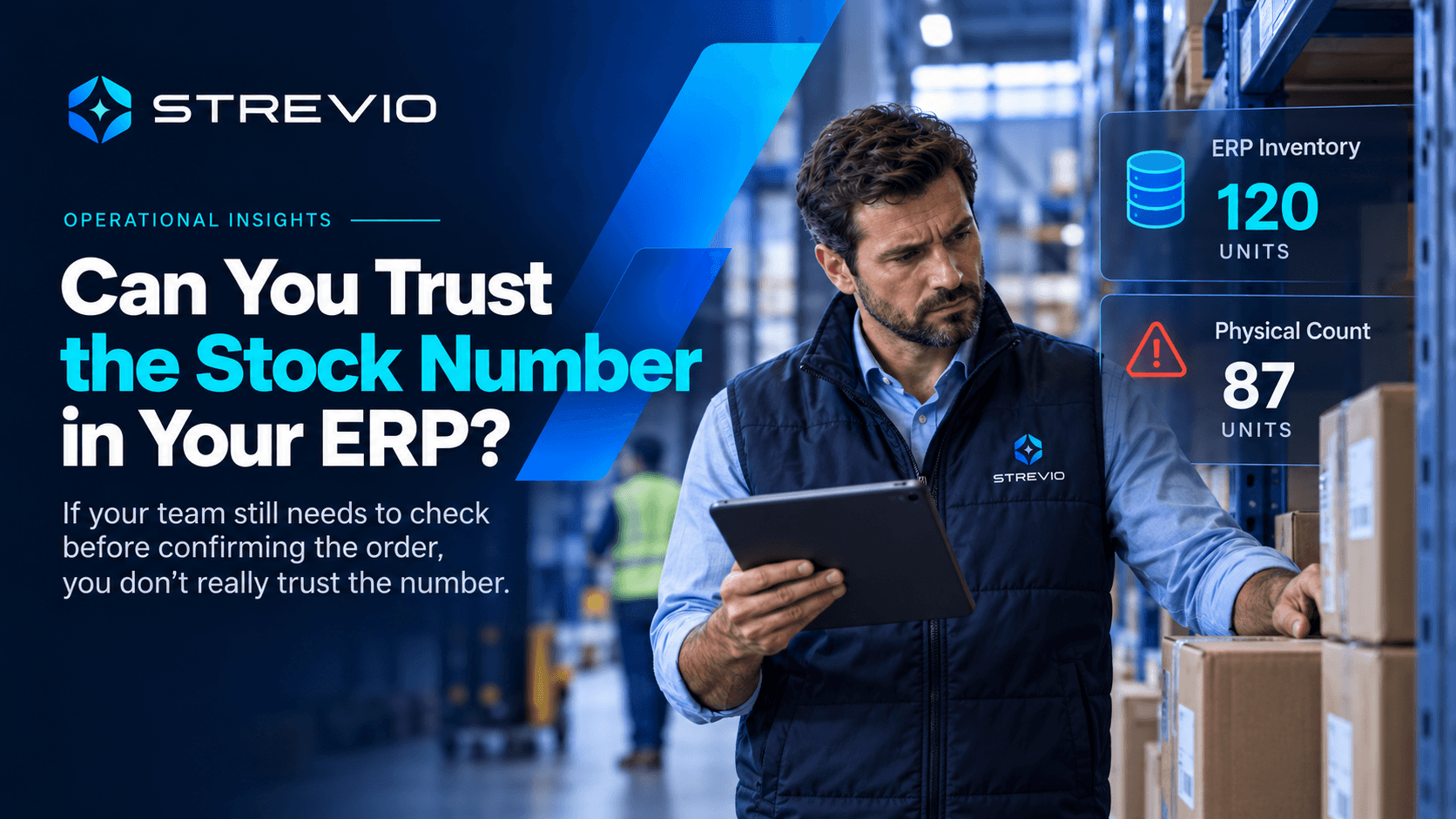
If your system says you have 100 units but your team still needs to check before confirming the order, you don't really have a stock number you trust.
In This Article
- The Number in the System Is Only Useful If People Believe It
- This Is Not a Small or Unusual Problem
- Your ERP Is Not Necessarily Wrong
- What Does "In Stock" Actually Mean?
- The Dangerous Version: The System Says You Have More Than You Really Do
- But the Opposite Problem Can Cost You Too
- This Is Why Inventory Accuracy Is Also a Cash-Flow Issue
- Better Inventory Accuracy Can Affect Sales Too
- "Available" Stock Is Often Where the Real Complexity Begins
- Customer-Paid Stock Creates Another Layer
- Incoming Stock Is Not the Same as Available Stock
- The Warehouse Can Be Right While the Business Is Still Wrong
- Adding Another Spreadsheet Usually Makes the Problem More Comfortable, Not Smaller
- Don't Automate the Wrong Stock Number
- Physical Counts Still Matter
- The Better Question Is Not "Is the Stock Accurate?"
- A Real STREVIO Example: When the Stock Number Could Not Be Trusted
- Seven Signs You Don't Really Trust Your Inventory
- What Should an Owner Ask?
- What Should Be Automated?
- What Should Stay Human?
- Better Inventory Visibility Should Reduce Questions, Not Create More Screens
- The End Goal Is Not Perfect Inventory. It Is Confident Decisions.
- Before You Buy More Stock, Hire More People or Replace the ERP
- The Question to Ask Tomorrow Morning
A customer calls.
Can you deliver 400 units next week?
Your ERP says you have 520. That should be an easy answer. Instead, someone says:
Let me check.
They ask the warehouse. They open another spreadsheet. They check what has already been allocated to other customers. Someone asks whether the supplier-held stock is included in the figure. Another person checks whether yesterday's shipment was properly deducted. There may be stock that a customer has already paid for. There may be incoming stock that has not arrived yet.
Twenty minutes later, the answer is:
We can actually promise 327.
So what exactly did the 520 mean?
This situation is surprisingly common in trading, wholesale, distribution and manufacturing businesses. The company has an ERP. The stock is recorded. The reports exist. Yet before somebody makes a real customer commitment, the team checks the number again. That is an important signal.
Because if your employees still need to verify the stock before they trust it, your problem is not simply inventory visibility. It is inventory credibility.
And when you cannot trust your inventory, the consequences spread much further than the warehouse. You can promise customers stock you do not actually have. You can reject orders you could have fulfilled. You can buy inventory that was already available. You can hold additional safety stock because nobody feels confident enough to run leaner. You can tie up cash unnecessarily. And every time the business grows, more people spend more time checking the same information.
The most expensive inventory problem is therefore not always running out of stock. Sometimes it is believing the wrong stock number.
The Number in the System Is Only Useful If People Believe It
Most business owners do not need perfect inventory. They need inventory information that is reliable enough to make decisions.
- Can we accept the order?
- Do we need to buy more?
- Which customer should receive the available stock?
- Can sales promise delivery next week?
- Do we really need this much safety stock?
- Can procurement wait before ordering again?
Those decisions depend on a very simple assumption: the stock information represents reality closely enough to trust it. When that confidence disappears, something interesting happens. Employees stop using the system as the answer. They use it as the starting point for an investigation.
The ERP says 80. The warehouse says, "Maybe." Excel says 67. The purchasing person says another 30 are coming. Sales believes 20 have already been promised. Someone else remembers that five cartons were damaged. Now the organization has several versions of the same answer.
And eventually, the most trusted system is not the ERP at all. It is the employee who happens to know what happened yesterday. That creates a hidden dependency on people. It also creates a hidden cost. Every customer order, replenishment decision and management question generates another round of checking.
Our own buying-moment research captures this frustration very simply:
I don't trust the stock numbers; we have to check manually.
The business consequence is not limited to warehouse administration. It includes poor customer commitments, repeated work, lost sales opportunities and working capital being tied up unnecessarily.
This Is Not a Small or Unusual Problem
Inventory records and physical inventory do not always match, even in businesses with established systems. APQC's inventory-accuracy benchmark contains data from 8,660 organizations.
95%
median inventory accuracy across 8,660 organizations, comparing electronically recorded inventory with the physical inventory that actually exists
APQC
A 95% median sounds good. And it is. But the broader lesson is important: having computerized inventory does not automatically mean the recorded inventory perfectly reflects the physical operation.
Research in retail environments shows the problem can be considerably larger.
50%–70%
of SKUs where discrepancies between computerized records and physical stock have been observed at a given point in time in some retail environments, per a 2025 academic review
Taylor & Francis Online
That figure should not be applied directly to a Hong Kong trading company or manufacturer. Retail has different operating conditions. But it demonstrates something useful for every business owner: inventory inaccuracy is not an unusual edge case that only happens in badly managed companies. It is a recurring operational problem.
The question is therefore not whether discrepancies can exist. The important question is:
How quickly does your business detect them, and how much damage happens before it does?
Your ERP Is Not Necessarily Wrong
This distinction matters. Owners sometimes become frustrated with their ERP:
We spent all this money on the system. Why is the stock still wrong?
But the ERP can only work from the transactions and information it receives. Imagine 100 units arrive. The warehouse receives them physically. But only 90 are recorded correctly. Or 10 units are damaged and the adjustment has not yet been entered. Or goods are moved from one location to another without the movement being properly captured. Or customer stock is shipped, but the deduction happens later. Or somebody performs a physical count while other stock movements are still taking place.
The computer is not independently looking at the warehouse floor. It is maintaining a record of what the business has told it happened.
Odoo's own documentation explicitly recognizes this reality. Its inventory-adjustment documentation explains that the quantity recorded in a warehouse system may differ from the actual quantity because of factors including damage, human error, theft and other discrepancies. Physical counts and adjustments are therefore required to reconcile the database with reality.
That's not a weakness unique to Odoo. It's the nature of inventory systems.
The system can faithfully record the wrong reality if the operational events feeding it are incomplete, late or incorrect.
This is why blaming the ERP alone rarely solves the problem. You first need to understand where reality and the record stop matching.
What Does "In Stock" Actually Mean?
This sounds like a stupid question. It isn't.
Imagine your business has 1,000 units of a product recorded. How many can you sell to the next customer? Perhaps all 1,000. But perhaps:
- 200 are already reserved for Customer A
- 150 were paid for by Customer B but have not shipped
- 75 are sitting in quality control
- 50 are damaged
- 100 are allocated to an order shipping tomorrow
- 200 are physically held by your supplier in China under an arrangement your team manages separately
- Another 500 are due to arrive next week
So what does "stock = 1,000" mean? Physical stock? Stock owned by the business? Stock currently in the warehouse? Stock not yet allocated? Stock available to promise? Stock expected next week? These numbers answer different questions.
Modern ERPs often make those distinctions. For example, Odoo's current stock reporting distinguishes On Hand, Free to Use, Incoming and Outgoing quantities. "Free to Use" represents on-hand stock not already reserved for delivery or manufacturing. Its Forecasted Report goes further, combining current stock with incoming and outgoing movements to project future availability.
So sometimes the problem is not that the system lacks information. The problem is that employees do not know which number answers the business question they are actually asking. When a customer wants 400 units next Friday, "how much stock do we have?" may be the wrong question. The better question is:
How much can we reliably promise this customer for that date without breaking another commitment?
That is an operational question.
The Dangerous Version: The System Says You Have More Than You Really Do
This is the situation business owners usually fear. The ERP says 100 units available. Reality is 72 units. Sales confirms 90.
Now the problem reaches the customer. Someone has to explain why the promised quantity cannot ship. Procurement may need to find replacement stock urgently. Logistics may need to expedite something. Customer service starts chasing. Management gets involved. Potentially, the customer needs to revise their own plans because your promise was based on stock that did not really exist.
APQC explicitly refers to this type of problem as phantom inventory: inventory the system considers available at a storage location that is not actually available there. The important word is not "phantom." The important word is available. Something can exist in a database and still be unavailable to the customer.
A large academic study of an international fashion retailer likewise describes inventory-record inaccuracies as a source of stockouts and revenue losses.
Inventory becomes a customer-service problem the moment you promise stock that isn't really there.
But the Opposite Problem Can Cost You Too
Suppose the system says 70 units. Reality is 100 units. That feels less dangerous. At least you won't disappoint a customer.
But the business can still lose money. Sales may reject an order that could have been fulfilled. Procurement may order another 30 units even though they already exist. The company may hold more inventory than necessary. Cash stays tied up. Warehouse space gets consumed. A supplier may receive an unnecessary replenishment order.
The system now creates costs because it understates reality rather than overstating it. Research on inventory-record inaccuracies distinguishes between these two directions because they lead to different operational consequences. Which leads to a very simple rule:
Bad inventory data can make you sell stock you don't have — or buy stock you didn't need.
Both are expensive. One disappoints customers. The other consumes capital.
This Is Why Inventory Accuracy Is Also a Cash-Flow Issue
Inventory is not just boxes. It is money that has been converted into boxes. When stock information is unreliable, businesses often protect themselves by carrying more inventory. The logic feels sensible:
We can't risk running out.
So purchasing orders earlier. Managers increase safety stock. The business keeps extra buffer. Nobody feels comfortable reducing inventory because nobody completely trusts what is available, what is incoming or what has already been committed.
But that protection has a cost. More stock means more working capital tied up. More warehouse space. More insurance. More handling. More risk of slow-moving or obsolete goods.
Fewer expedites, lower carrying cost
APQC's 2025 research found higher inventory accuracy was associated not only with better order-fill performance but also with fewer expedited orders and lower inventory carrying cost as a percentage of inventory value
APQC
That connection is important. When people think about inventory accuracy, they often imagine a warehouse employee counting boxes. The business owner should be thinking about something much larger:
How much money am I keeping in inventory because I don't fully trust the information used to manage it?
Better Inventory Accuracy Can Affect Sales Too
There is interesting research on this. A 2025 grocery study examined around 24,000 SKUs across 11 stores and studied what happened when physical inventory audits corrected inaccurate system records.
11%
store-wide sales lift following inventory audits in a 2025 grocery study of ~24,000 SKUs across 11 stores, concentrated in products where the system believed more stock existed than was physically available
arXiv, 2025 grocery inventory study
Again, this was grocery retail. It does not mean correcting a Hong Kong wholesaler's inventory will magically increase sales by 11%. But the mechanism is relevant well beyond retail: if the system believes stock is available when it isn't, replenishment and selling decisions can be wrong. If the information becomes accurate, the business can make better decisions.
That is why physical stock checking should not be dismissed as administrative housekeeping. In some environments, it directly protects revenue.
"Available" Stock Is Often Where the Real Complexity Begins
For many trading businesses, physical warehouse inventory is only one part of the story. You may also manage:
- Supplier-held stock
- Dropshipping inventory
- Customer-paid inventory
- Goods in transit
- Partially shipped orders
- Customer allocations
- Consignment stock
- Backorders
- Incoming containers
- Returns
- Damaged units
- Inventory spread across multiple locations
This is exactly what we have seen in real trading operations. In one STREVIO international-trading case, supplier-held and dropshipping stock had to be reconciled manually. Supplier invoices had to be matched with stock references. Shipped quantities were manually deducted. Remaining quantities and backorders were repeatedly recalculated.
The challenge was not that the business had no ERP. The ERP existed. The challenge was that operational reality extended beyond the clean transaction boundaries inside it.
This happens often. The system may know exactly what is physically in Warehouse A. But the owner wants to know:
Can I accept this customer order?
To answer that, they may need to combine warehouse stock, supplier-held stock, existing allocations, open purchase orders, backorders and customer commitments. That is why a business can have excellent transactional records and still struggle with practical availability.
Customer-Paid Stock Creates Another Layer
Consider a business where customers pay for stock that remains temporarily at the supplier or warehouse. Legally or commercially, those units may already belong to a particular customer. Physically, they may still sit next to unallocated stock.
The ERP may show 500 units. But perhaps 180 should never be offered to another buyer. If those allocations are maintained separately in Excel, someone now needs to remember to deduct them whenever a new order is considered. Every manual adjustment introduces another opportunity for discrepancy.
This was one of the operational problems identified in our trading work: paid or dropship inventory required recurring manual reconciliation and deductions, creating risks around both availability and margins.
So before automating anything, the company needs to define something surprisingly basic:
What does "available" mean in our business?
Until everybody agrees on that rule, putting a faster dashboard on top of the data simply gives you the wrong answer faster.
Incoming Stock Is Not the Same as Available Stock
Another common mistake is treating incoming stock as if it were already usable. A supplier confirms 500 units. The purchase order says the stock should arrive next Monday. Sales sees the incoming quantity and makes a customer commitment for Tuesday.
Then the supplier is delayed. Or the vessel changes. Or customs takes longer. Or the shipment arrives incomplete. The 500 units technically existed in the pipeline. They were never actually available when the customer needed them.
Modern systems can help forecast this. Odoo, for example, calculates forecasted inventory using on-hand stock, incoming quantities and outgoing demand and shows the expected timing of stock movements. But forecast quality still depends on the quality of the dates feeding it. If the supplier changed the arrival date yesterday and nobody updated the information, the forecast can still look perfectly logical while being operationally wrong.
This connects directly to the supplier-chasing problem we discussed in the previous article. Inventory accuracy and supplier visibility are not separate problems. The stock available tomorrow depends partly on whether the supplier commitment is still true today.
The Warehouse Can Be Right While the Business Is Still Wrong
This sounds contradictory. Imagine the physical stock count is perfect. Every unit is exactly where the warehouse system says it is. Excellent.
But customer allocations are maintained somewhere else. Or incoming supplier dates are outdated. Or customer-paid stock is managed in Excel. Or the sales team cannot see reservations clearly. Or one business unit has promised stock without that commitment being visible to another.
The warehouse count may be 100% accurate. The business can still make the wrong promise.
That is why "inventory accuracy" needs a broader operational interpretation. Physical count accuracy is foundational. But the business ultimately cares about decision accuracy. Can it confidently decide what it can sell, when it can deliver, what it needs to buy, and which orders are at risk? A perfectly counted warehouse is valuable. A perfectly counted warehouse connected to inaccurate commitments is not enough.
Adding Another Spreadsheet Usually Makes the Problem More Comfortable, Not Smaller
When people stop trusting the ERP number, they often create another spreadsheet. That makes sense. Excel is flexible. Someone builds columns for stock, allocated, paid, shipped, incoming, backorder, balance, and available.
Now the business has a better operational view. For a while. Then the spreadsheet needs to be updated. ERP exports are downloaded. Supplier files change. Yesterday's shipments need deducting. New allocations need adding. Someone creates another version. Another employee keeps a slightly different tracker.
The spreadsheet solves the immediate visibility gap but introduces a maintenance burden. This is precisely what happened in one STREVIO trading case. Odoo data was exported and reprocessed in Excel, remaining quantities were recalculated manually, backorders were tracked in spreadsheets, dropshipping stock lived outside the normal ERP workflow and management views had to be rebuilt.
The problem was not Excel. The problem was that the spreadsheet had become operational infrastructure maintained by people. As order volume increased, so did the workload required to keep the answer accurate.
Don't Automate the Wrong Stock Number
There is a temptation when businesses discover this problem:
Let's automate the spreadsheet.
Sometimes that helps. But there is a more important question first: why does the spreadsheet exist? Maybe the ERP configuration needs improving. Maybe supplier-held inventory is not represented correctly. Maybe allocations are not being captured. Maybe physical movements happen before the system gets updated. Maybe customer-paid stock needs its own rule. Maybe two departments define "available" differently. Maybe the data genuinely needs to come from several systems.
If you automate before understanding that, you can create a beautifully automated incorrect number. This is the same principle we keep returning to across Operational Capacity:
Understand the operational problem before choosing the technology.
Because the target is not "automated inventory." The target is better business decisions.
Physical Counts Still Matter
Automation does not remove the physical world. Someone eventually needs to confirm that what the system says exists actually exists. That may mean annual stocktakes. Cycle counts. Barcode scanning. Location checks. Reconciliation of damaged goods. Reviewing repeated discrepancies.
Odoo's inventory functionality explicitly supports physical counting and inventory adjustments for exactly this reason. The important distinction is between counting stock and spending every day manually rebuilding stock visibility.
Physical verification is a control. Constant operational checking is often a symptom. A healthy process should use counts to correct and improve the system. It should not require sales or procurement to start another mini stocktake every time a customer asks a question.
The Better Question Is Not "Is the Stock Accurate?"
Almost no complex operation will be permanently perfect. A better question is:
How does the business know when something is wrong?
Suppose a stock discrepancy appears. Does somebody have to discover it accidentally? Or does it surface quickly? Are certain products repeatedly wrong? Does one warehouse generate more adjustments? Do particular workflows create mismatches? Does supplier-held stock regularly drift? Do discrepancies appear after certain transactions? Is one category responsible for most manual corrections?
That changes inventory management from "Check everything because we don't trust anything" to "Focus on the places where the operation is telling us something is wrong." That is management by exception. And it is much more scalable.
A Real STREVIO Example: When the Stock Number Could Not Be Trusted
Hong Kong food-import and distribution company
One Hong Kong food-import and distribution company managed overseas suppliers, incoming shipments, inventory, customer orders and local deliveries. The company already had operational systems. But one very simple question became difficult: "Is the stock in the system the real stock?"
Before confirming customer orders, employees regularly needed to verify the answer manually. When a supplier was late, they also needed to understand which products and customers would be affected. That information had to be reconstructed across systems, spreadsheets and emails. Incoming stock was reconciled manually. Customer orders were checked against availability. Shipment information had to be chased. And when the information was wrong, the consequence reached the customer: "We told the customer yes, then discovered we could not deliver."
The solution did not start by replacing every existing system. Inventory, purchasing, incoming shipments and customer orders were connected into one operational view. Stock and order requirements became easier to reconcile. Supplier and shipment exceptions were surfaced earlier. Teams could see which customer orders were affected by unavailable or delayed stock without manually tracing the problem across multiple systems.
Measured Results
- 50% faster inventory reconciliation and stock verification
- 80% less manual operational reporting
- 30% more orders processed by the same operational team
- Live visibility across inventory, suppliers, incoming shipments and customer orders
That is the business opportunity. Not merely "better inventory reporting." More orders handled with less time wasted verifying information.
Read the full Food Import & Distribution storySeven Signs You Don't Really Trust Your Inventory
You can usually recognize this problem without running a sophisticated study.
1. Someone says "let me check" before confirming stock
Occasional checking is normal. Routine checking before almost every important order is not.
2. Sales has its own stock spreadsheet
That usually means the ERP number does not answer the question sales actually needs answered.
3. Procurement keeps buffer stock because nobody feels safe reducing it
That may be a supplier-risk issue. It may also be an information-confidence issue.
4. Staff frequently discover that "available" stock is already committed
Your allocation information and your inventory view are disconnected.
5. Physical counts regularly produce surprising adjustments
Differences happen. Repeated large surprises suggest the business should understand why.
6. Customer service needs operations to investigate availability
The information required to answer customers is dependent on another team.
7. Different people give different answers to "How many can we sell?"
This is perhaps the clearest sign of all. If sales says 300, procurement says 420 and the warehouse says 280, you do not have an inventory number. You have three interpretations.
What Should an Owner Ask?
You don't need to become an inventory specialist. Ask practical questions.
- When the ERP says 500 units, what exactly does that number include?
- Are customer allocations already deducted?
- What about stock paid for but not shipped?
- What about damaged goods?
- What about stock held at suppliers?
- What about stock in transit?
- What about other warehouses?
- How are returns treated?
- How quickly are physical movements reflected in the system?
- What causes most stock adjustments?
- How often do staff need to verify stock manually before confirming orders?
- How often do we promise customers quantities we later have to revise?
- How much stock do we keep purely because we are uncertain?
- Can sales see the quantity genuinely free to sell?
- If a supplier is late today, can we immediately see which customer commitments become risky?
The quality of the answers tells you much more than simply asking "Do we have inventory software?"
What Should Be Automated?
The goal is not to automate physical reality. The goal is to stop people repeatedly reconstructing information that the business already has. Depending on the operation, useful automation may include:
- Bringing ERP stock and external stock information together
- Reconciling supplier-held inventory
- Capturing incoming quantities
- Monitoring backorders
- Matching supplier documents to stock references
- Deducting shipped quantities
- Surfacing discrepancies
- Identifying orders affected by unavailable stock
- Updating recurring operational reports
- Alerting people when inventory crosses a meaningful threshold or conflicts with a commitment
Our international-trading case is a good example. By connecting ERP data, Excel logic, supplier-held stock information and supplier invoices, remaining-quantity calculations, backorder monitoring, invoice reading, stock reconciliation and shipped-quantity deductions could be automated. The company reduced the time spent rebuilding the operational workflow by 50–60%.
Notice what was automated: the repetitive reconstruction and checking. Not the commercial decision.
What Should Stay Human?
People should still decide:
- Whether an important customer receives scarce stock
- Whether to expedite a shipment
- Whether a supplier's repeated failure is acceptable
- How much safety stock the business wants strategically
- Whether to write off damaged goods
- Whether to accept an unusual customer request
- When inventory risk justifies changing the commercial plan
Those are business decisions. Technology should make the relevant information available earlier and more reliably. It should not pretend judgment is unnecessary.
Automate the checking. Keep people responsible for the decision.
Better Inventory Visibility Should Reduce Questions, Not Create More Screens
There is a danger with dashboards. A company has an inventory problem. So somebody creates a massive dashboard. Now the business has 50 charts. Nobody knows which one matters.
Visibility should make operations simpler. A useful stock view should help a team answer things like:
- What can we sell now?
- What can we promise next week?
- Which incoming stock is late?
- Which customer orders are at risk?
- Which products show unusual discrepancies?
- Which inventory needs verification?
- What is already committed?
- What stock is genuinely free to use?
- Which backorders are waiting for incoming supply?
- Which issues require action today?
If your new dashboard produces more questions than answers, it is not yet operational visibility.
The End Goal Is Not Perfect Inventory. It Is Confident Decisions.
No business owner should spend their life chasing a theoretical 100% perfect dataset. The purpose of inventory information is to operate the business.
- Can your team make customer commitments confidently?
- Can procurement buy at the right time?
- Can management control working capital?
- Can operations identify discrepancies before they create customer problems?
- Can the business handle more orders without adding people whose main role is checking whether the numbers are true?
That is the standard that matters. A stock system is successful when the people operating the business can use the information to make decisions without rebuilding reality every time.
Before You Buy More Stock, Hire More People or Replace the ERP
If your inventory numbers are unreliable, three reactions are common: buy more stock, hire another operations person, replace or customize the ERP. Any of those may eventually be justified. But first understand the problem.
- Where does the stock record drift from reality?
- What information sits outside the ERP?
- Which quantities require recurring manual reconciliation?
- Which customer commitments are invisible to the stock calculation?
- Which supplier updates change availability?
- Why does the spreadsheet exist?
- What are your employees actually checking every day?
You may discover that you do not need more stock. You need more confidence in the stock you already have. You may not need another employee. You may need to remove the checking work consuming the existing team. And you may not need another ERP. You may need to connect the operational information surrounding the one you already use.
The Question to Ask Tomorrow Morning
Open your inventory system. Choose an important product. Look at the number. Then ask the person who actually manages the business:
Can I promise that quantity to a customer right now?
If the answer is "Yes." Great. If the answer is "Wait, let me check." Pay attention to everything that happens next. Which spreadsheet gets opened? Who gets called? What has to be deducted? Which information is missing? Which supplier needs checking? What customer commitment wasn't visible? How long does it take to reach the real answer?
That little investigation will tell you more about your Operational Capacity than another management report. Because every manual step between "What does the system say?" and "What can we actually promise?" is operational capacity your business may be able to recover.
Not Sure Where Your Business Is Losing Capacity?
That's Exactly What This Is For
When you work inside a business every day, inefficient workarounds stop looking like workarounds — they simply become “the way we do things.” That's exactly why we built the STREVIO Free Operational Capacity Assessment: a self-service, 3-minute check with no consultation and no technical knowledge required, giving you a first view of where your business may be losing time, profitability and visibility, and where to look first.
Take the Free Operational Capacity AssessmentFrequently Asked Questions
Why doesn't the stock in my ERP match the physical inventory?
Recorded stock can drift from physical stock for many reasons: receiving errors, missed transactions, damaged goods, incorrect movements, timing differences, theft, returns, manual adjustments or simple human error. Odoo's own inventory documentation notes that recorded and actual quantities can differ and provides physical inventory adjustments specifically to reconcile those differences.
What is phantom inventory?
Phantom inventory is stock the system believes is available but which is not actually available in the expected location. APQC includes phantom inventory among the discrepancies organizations should monitor when comparing electronic inventory records with physical stock.
What is the difference between on-hand stock and available stock?
On-hand stock generally refers to the quantity physically recorded in inventory. Available stock may exclude quantities already reserved or committed. For example, Odoo's current stock reporting distinguishes On Hand from Free to Use, which represents quantities not already reserved for delivery or manufacturing. The exact business definition of "available" should reflect the commitments relevant to your company.
What is forecasted inventory?
Forecasted inventory looks beyond what exists today and considers expected incoming and outgoing stock. Odoo 19, for example, calculates forecasted quantities using on-hand inventory, incoming movements and outgoing demand. Forecast quality depends on the accuracy of the information feeding those expected movements.
How accurate should inventory be?
There is no single percentage suitable for every company or product. APQC's benchmark across 8,660 organizations reports a median inventory accuracy of 95%, but the appropriate target depends on your products, order volumes, inventory value, business model and consequences of being wrong. More important operationally is understanding where errors occur and whether they affect customers, replenishment decisions or working capital.
Should we perform physical stock counts even if we use an ERP?
Yes. The physical operation and system records can diverge, so physical counts remain an important control. The frequency and method depend on the business. Some companies use annual stocktakes, while others perform regular cycle counts on selected inventory.
Can inventory reconciliation be automated?
Parts of it can. Businesses can automate recurring comparisons, deductions, document matching, calculations, exception detection and reporting. Physical verification and decisions about unexplained discrepancies still require human ownership.
Can Odoo manage inventory accurately?
Odoo provides substantial inventory functionality, including on-hand quantities, free-to-use stock, incoming and outgoing movements, forecasted inventory, reservations, physical counts and inventory adjustments. Whether the resulting information reflects operational reality depends on how the business is configured and how accurately and promptly stock movements, allocations and external information are captured.
Should I replace my ERP if staff still use Excel for stock?
Not necessarily. First understand why Excel exists. It may be compensating for a missing ERP configuration, external supplier information, customer allocations, special stock rules or a cross-system visibility problem. Once you understand the role the spreadsheet is playing, you can decide whether the right answer is ERP configuration, integration, automation or another tool.
How can inaccurate inventory affect working capital?
If management does not trust availability, the business may buy earlier or hold more safety stock than necessary. If system inventory understates physical inventory, procurement may also reorder products the business already owns. APQC reports an association between higher inventory accuracy and lower inventory carrying costs.
How does inventory accuracy affect customers?
Incorrect inventory can lead to orders being promised against stock that is unavailable, slower confirmation, backorders, emergency substitutions or delayed delivery. In STREVIO's Hong Kong food-distribution case, one recurring problem was exactly this: "We told the customer yes, then discovered we could not deliver." After inventory, purchasing, incoming shipments and customer orders were brought into a clearer operational view, inventory reconciliation became 50% faster and the existing team processed 30% more orders.
About The Author
Alexandre Besson
Co-Founder & Chief Business Strategist, STREVIO
After more than 20 years running operations across Europe and Asia, Alexandre focuses on helping SMEs remove the manual coordination, information gaps and repetitive work that make businesses harder to run as they grow. STREVIO helps businesses recover Operational Capacity by connecting the systems and information they already use, improving operational visibility and orchestrating workflows so existing teams can handle more business without adding people, cost and complexity at the same rate.